Products

Everything RMS doesand what each one saves you.

The document
Everything needed to produce a finished, signed-off report from the field.
The job
The reading and the re-keying done for you, on top of everything before it.
The business
History and pipeline, on top of everything before it.
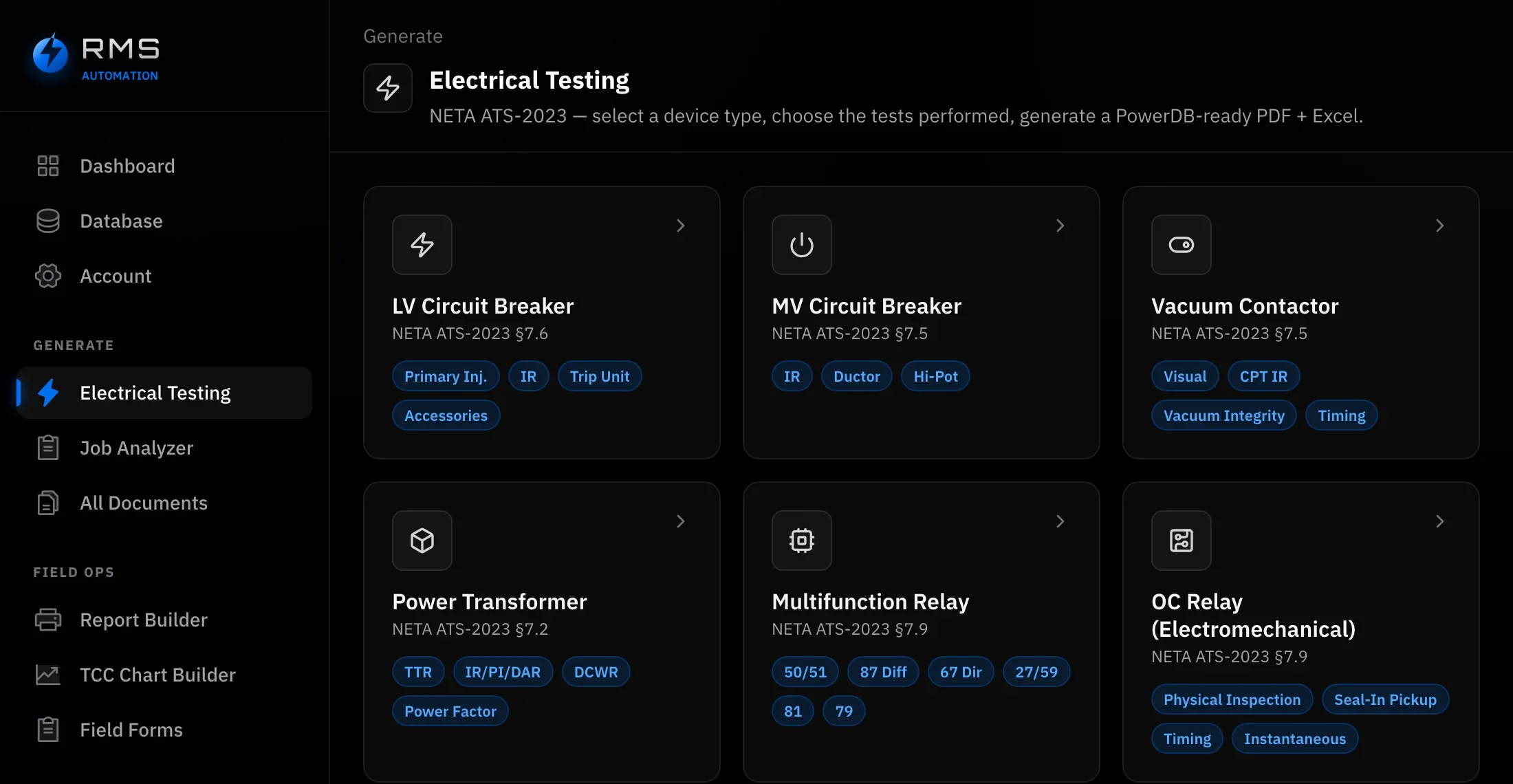
The RMS Automation electrical testing screen: a grid of device cards (LV circuit breaker, MV circuit breaker, vacuum contactor, power transformer, multifunction relay, overcurrent relay), each labelled with a NETA section and the tests it covers.
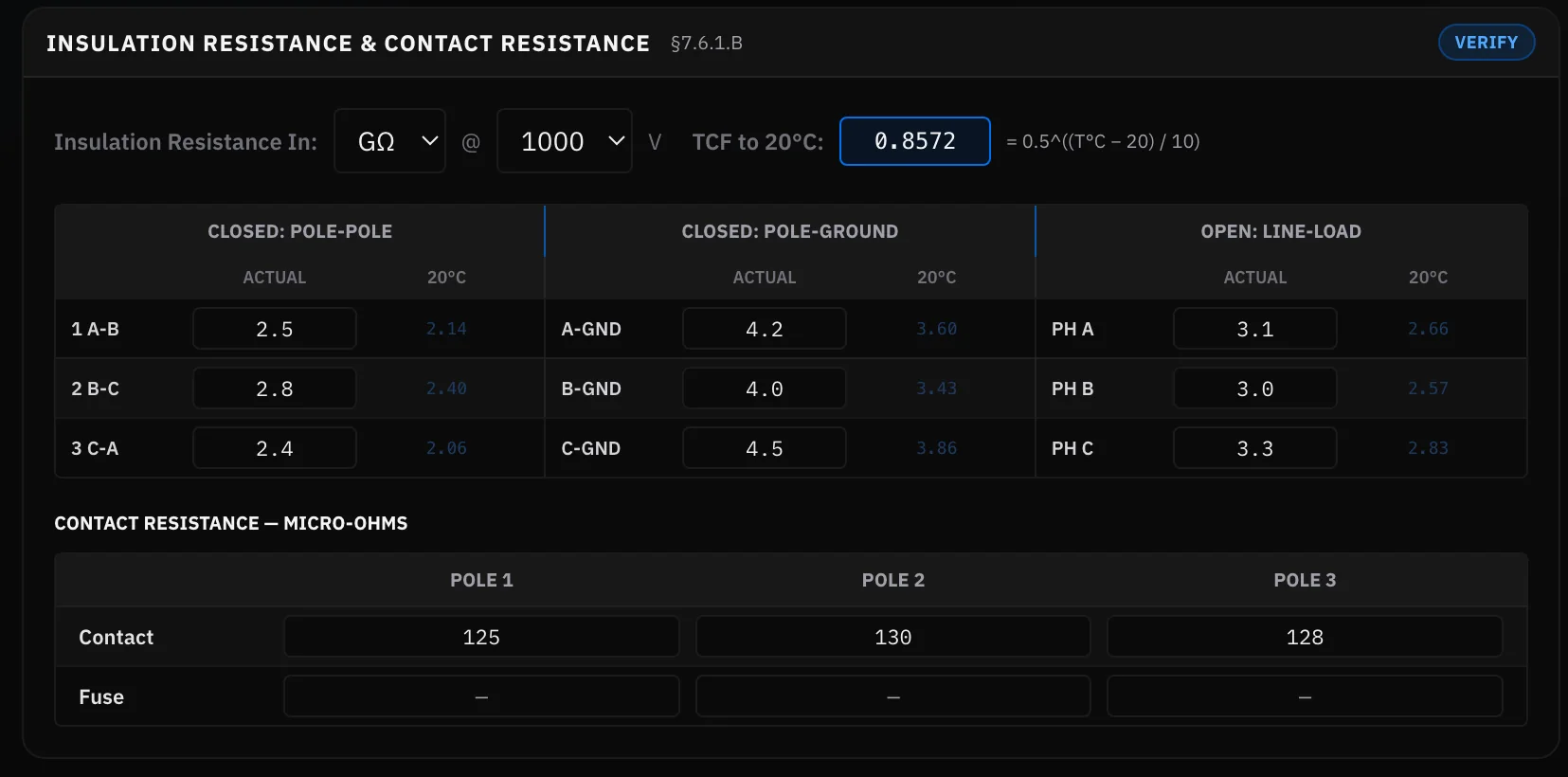
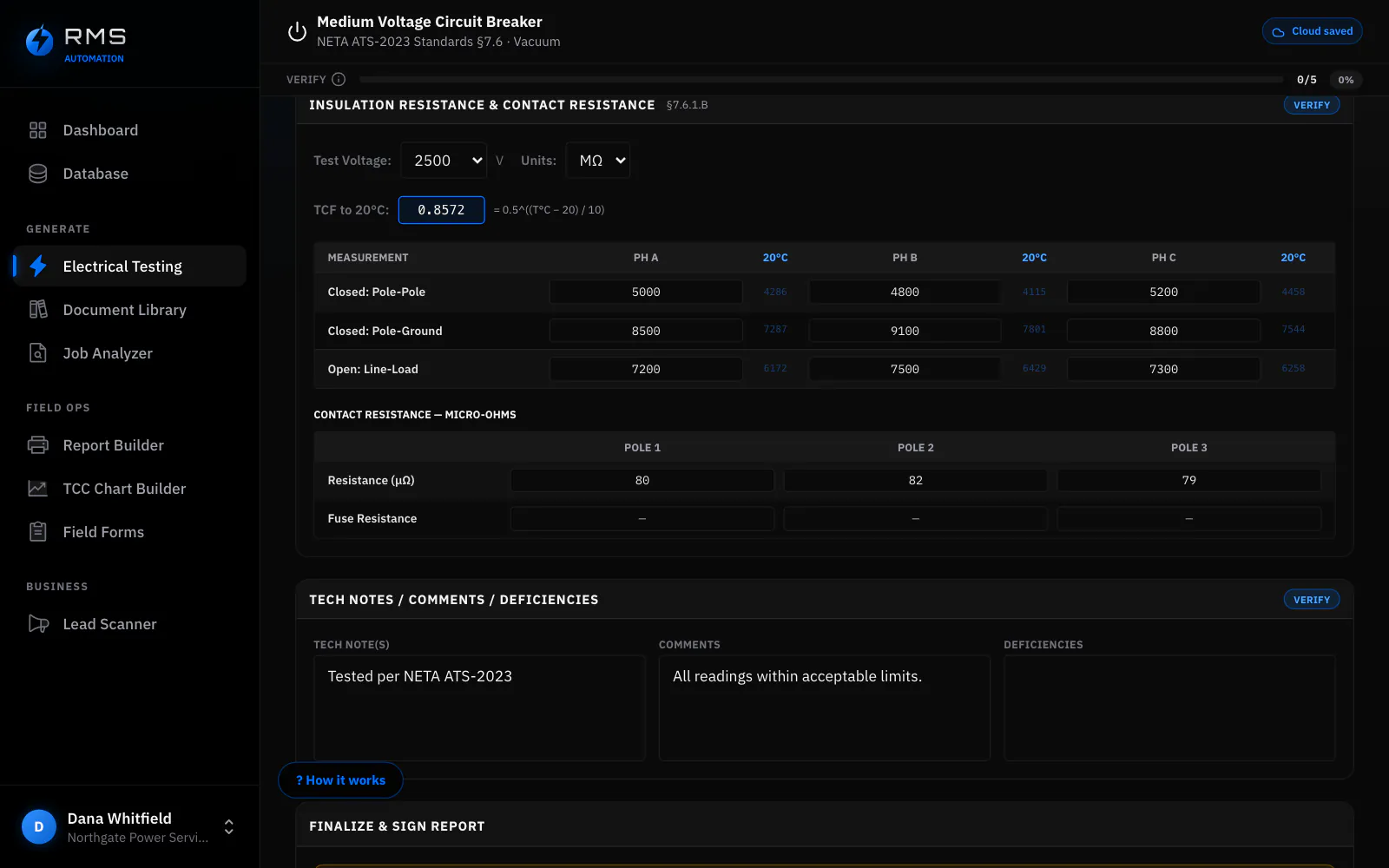
The medium-voltage circuit breaker form, open at its insulation resistance and contact resistance section. A temperature correction factor of 0.8572 is shown with the formula it comes from, above a grid of per-phase megohm readings for closed pole-to-pole, closed pole-to-ground and open line-to-load, then contact resistance in micro-ohms per pole.
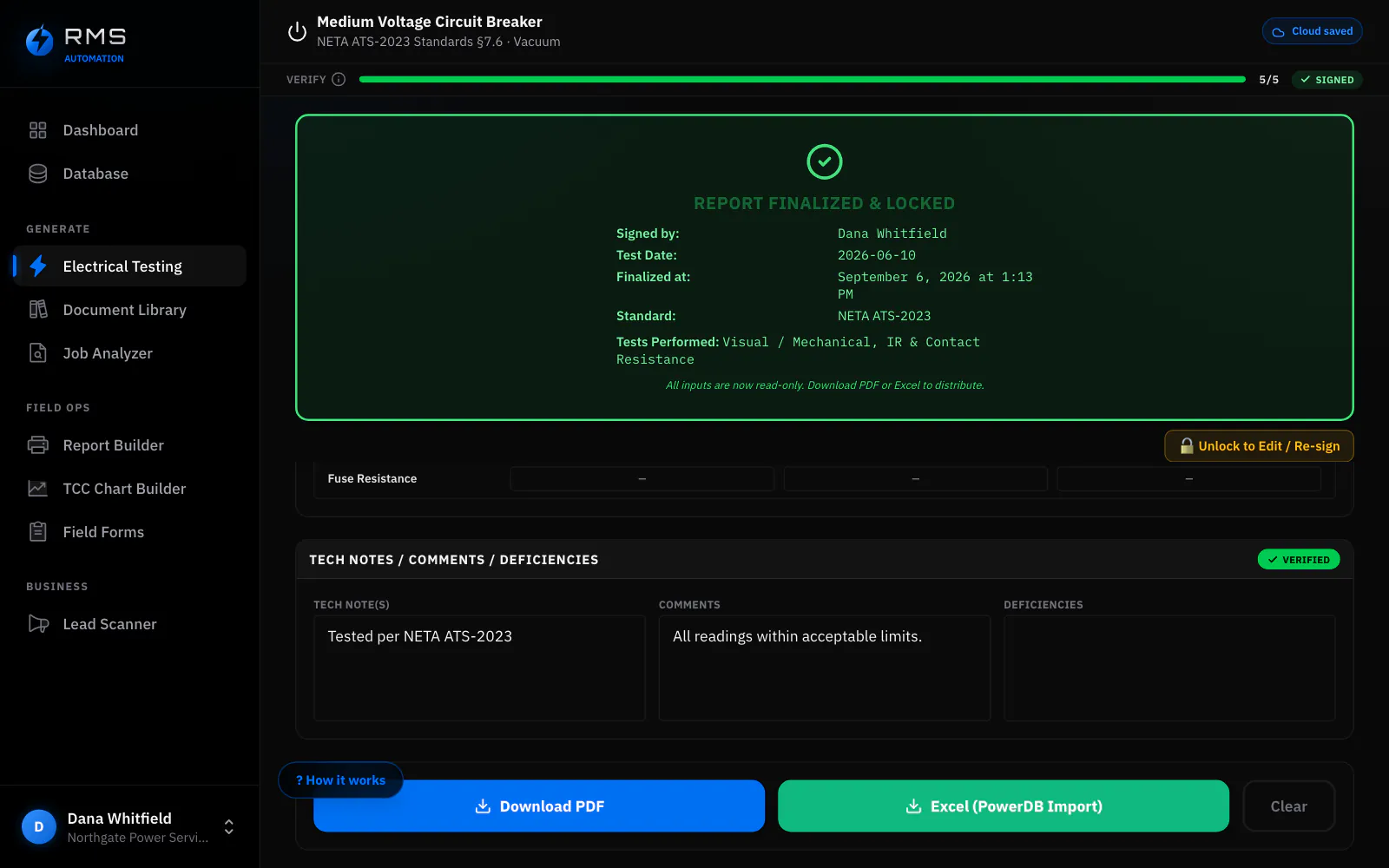
The same breaker form after signing. A “Report Finalized & Locked” banner names the signer, the test date, the finalize timestamp, the standard applied and the tests performed, and states that all inputs are now read-only. At the foot of the form are the two export buttons (Download PDF and Excel (PowerDB Import)) beside an Unlock to Edit / Re-sign control.
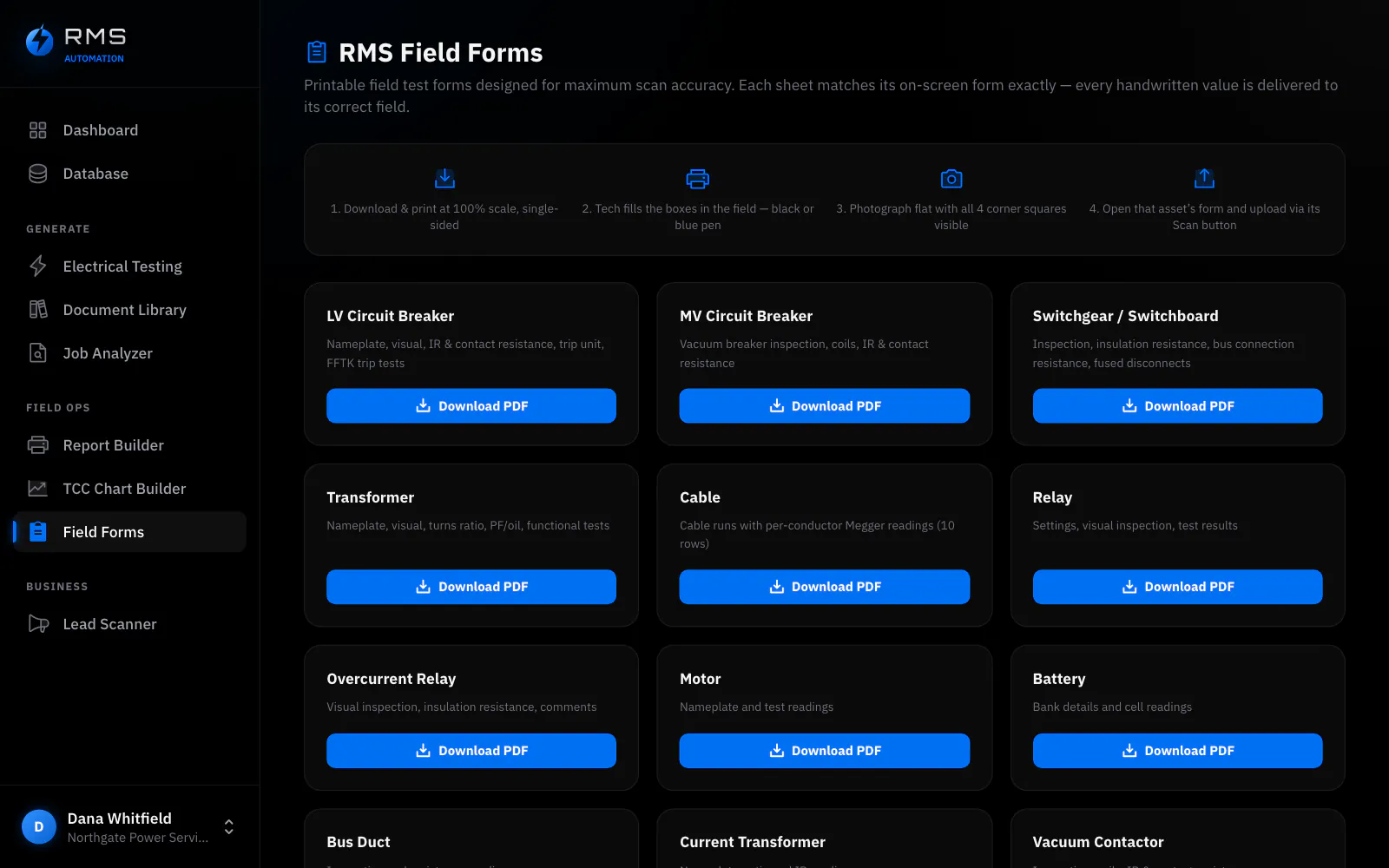
The Field Forms page: printable versions of the same test sheets, above four numbered instructions: print at 100% scale single-sided, fill the boxes in black or blue pen, photograph flat with all four corner squares visible, then upload through the asset’s Scan button. Below is a grid of download cards, one per device type, each listing the tests its sheet covers.

Document level

Electrical testing forms

  • Transformers, breakers, relays, cable, CTs, switchgear
  • Insulation resistance corrected to 20 °C, contact resistance in micro-ohms
  • Out as a branded PDF and as PowerDB-compatible CSV, written with the tag names it expects
  • Photograph a completed paper form and the handwriting is read into the record
  • BasicIncluded
  • PremiumIncluded
  • UnlimitedIncluded
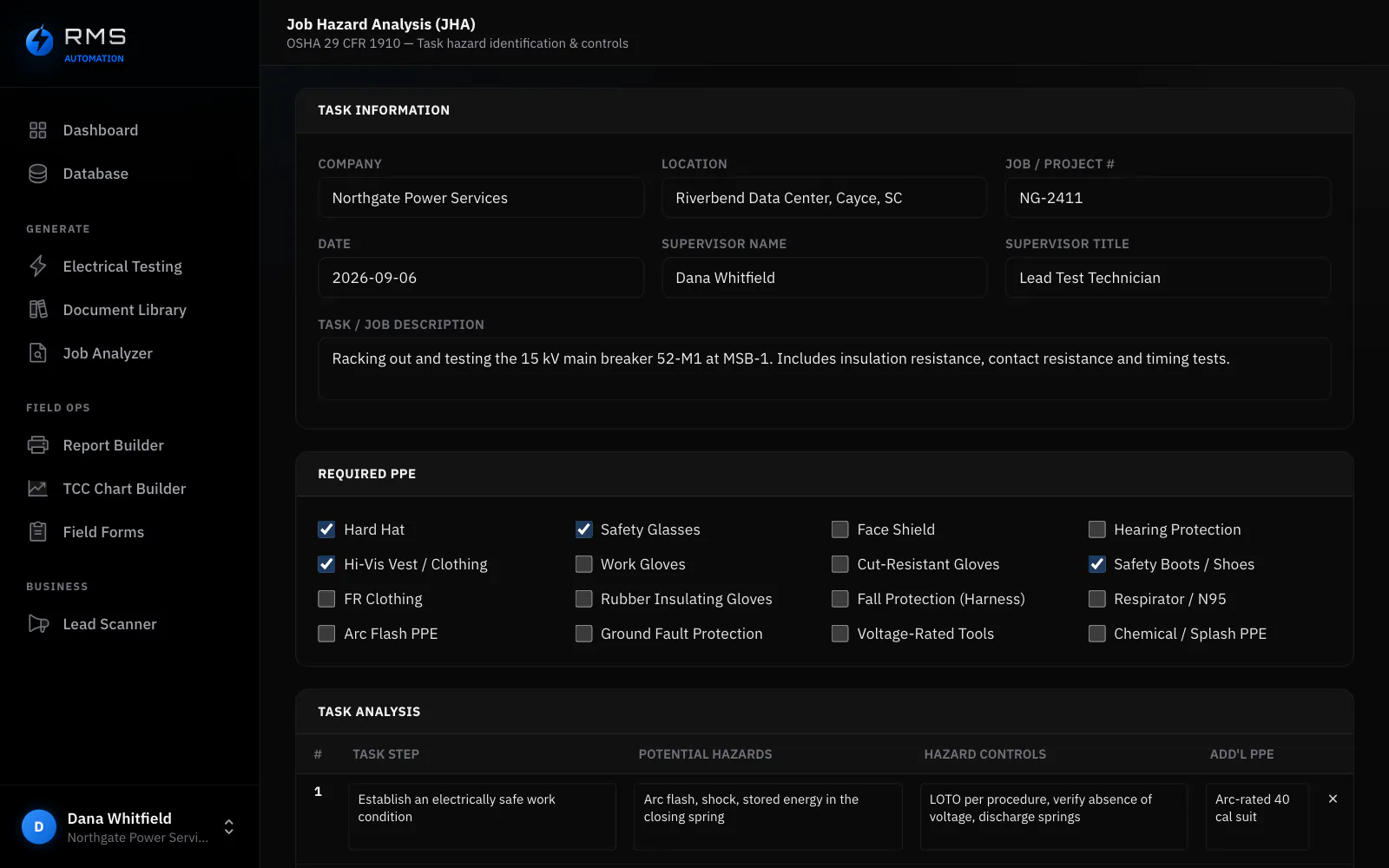
A Job Hazard Analysis under OSHA 29 CFR 1910. The task is described as racking out and testing the 15 kV main breaker 52-M1 at MSB-1, including insulation resistance, contact resistance and timing. Below it a checklist of sixteen PPE items, then the task analysis table, step one is establishing an electrically safe work condition, with arc flash, shock and stored spring energy as the hazards and LOTO, voltage verification and spring discharge as the controls.
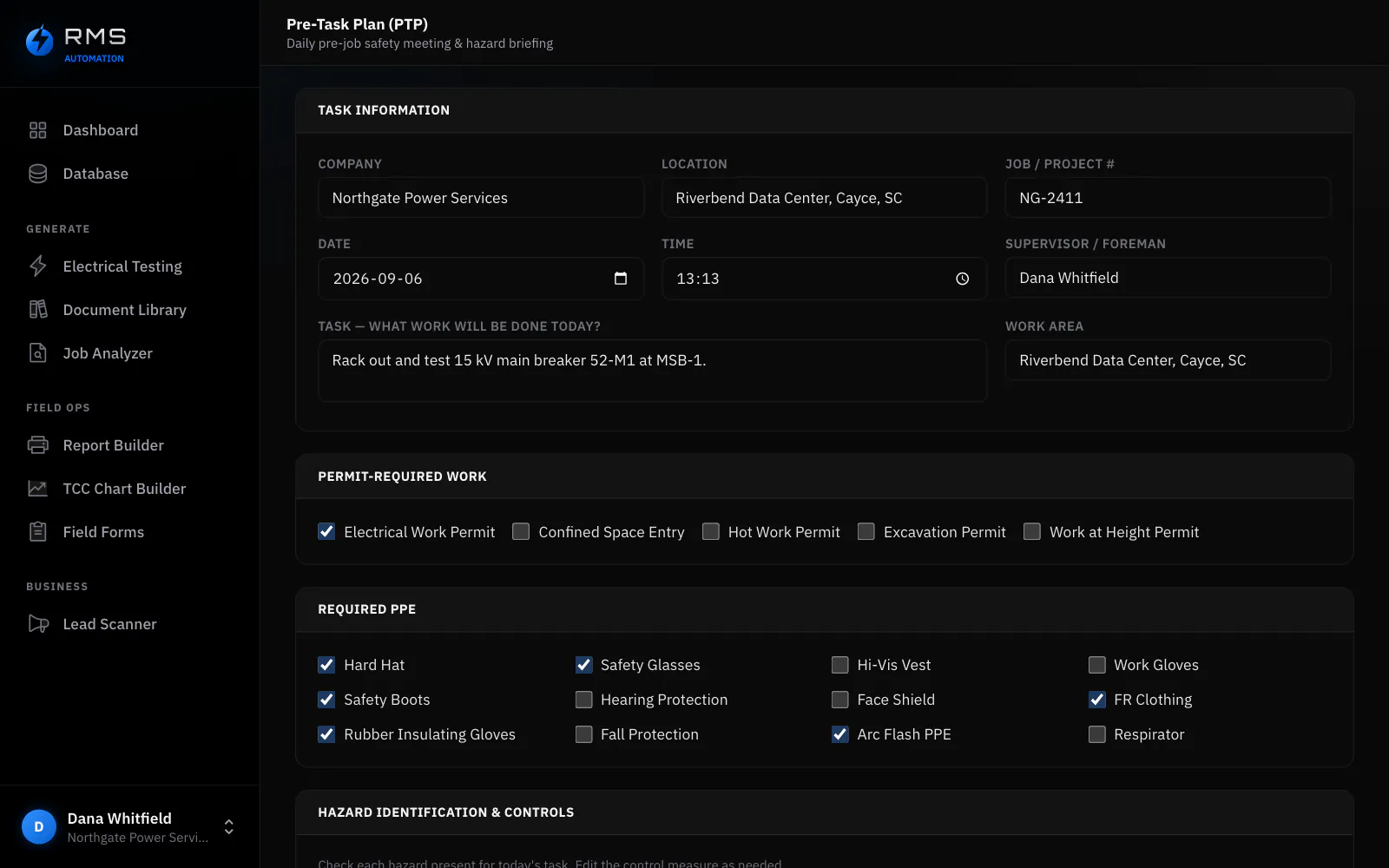
A Pre-Task Plan for the daily safety briefing. Task information at the top, then the day’s work written out (rack out and test 15 kV main breaker 52-M1 at MSB-1) followed by the permits that may be required, a twelve-item PPE checklist, and the start of the hazard identification section with its instruction to check each hazard present and edit the control measure as needed.
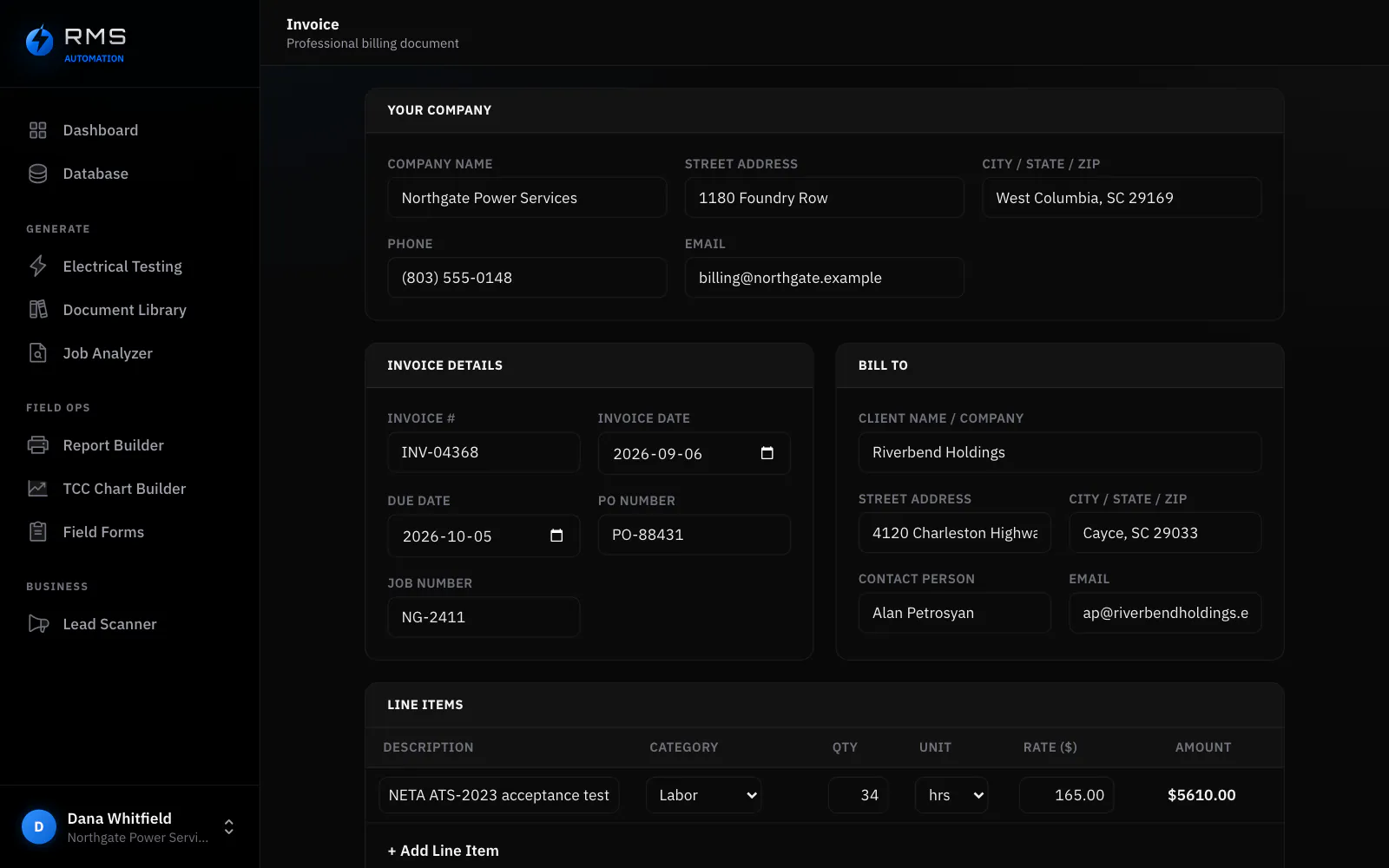
The invoice builder. Sender details on the left, invoice number, dates, PO number and job number on the right, then the bill-to block and a line-items table with description, category, quantity, unit, rate and amount, totalling $5,610.00, with a control to add another line.
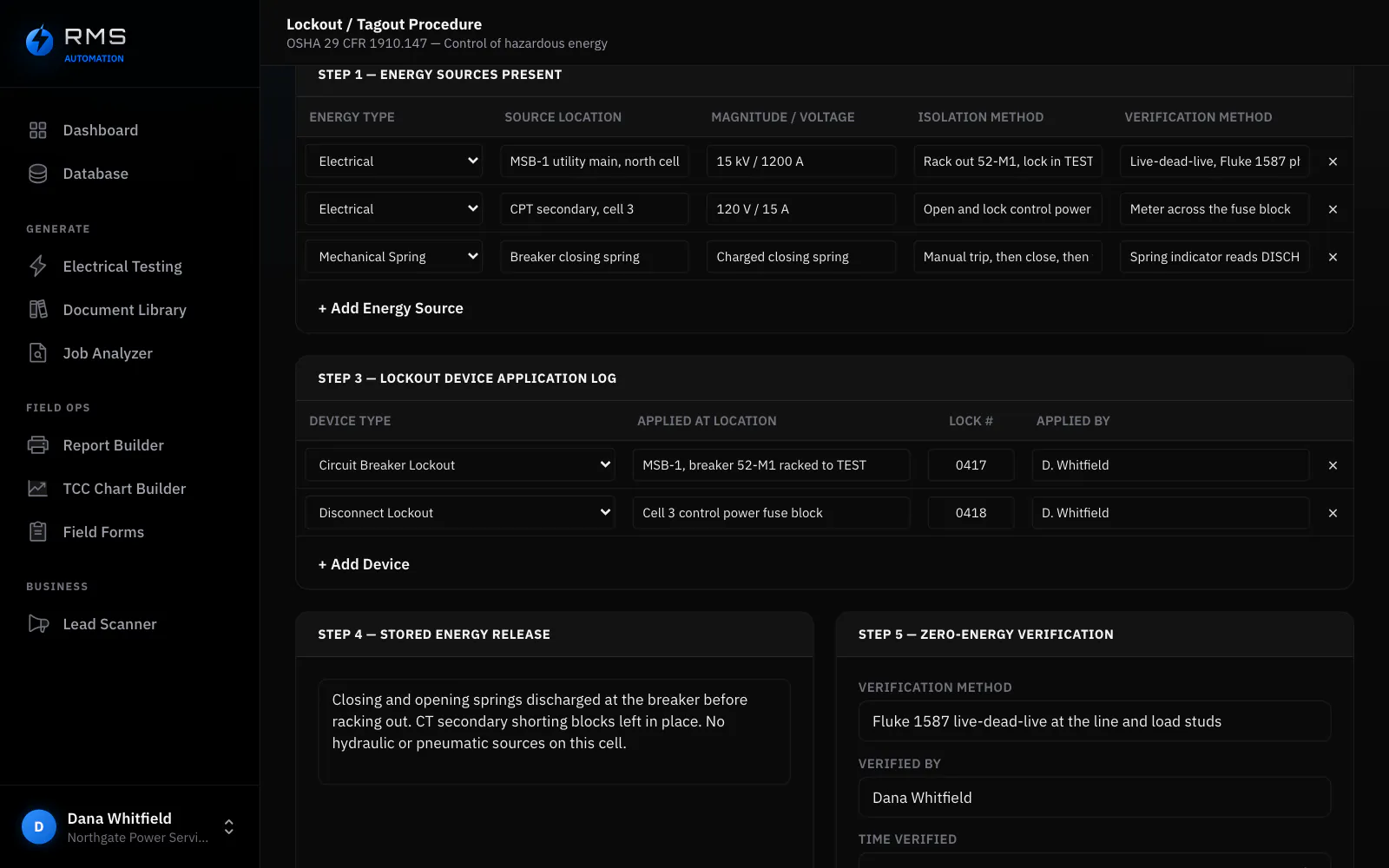
A Lockout/Tagout procedure under OSHA 29 CFR 1910.147, written for a three-year maintenance interval on a 15 kV main breaker. It carries a table of energy sources present (type, location, magnitude, isolation method and verification method) a lockout device application log recording device type, location, lock number and who applied it, a stored-energy release note about discharging the closing and opening springs before racking out, and a zero-energy verification block.

Document level

Safety & business documents

  • JHA, LOTO and PTP built to the OSHA sections that govern them
  • Lockout plans that name every energy source, not just the obvious one
  • Invoices and field reports that print under your company’s name, never ours
  • No document downloads until the fields that make it mean something are filled
  • BasicIncluded
  • PremiumIncluded
  • UnlimitedIncluded
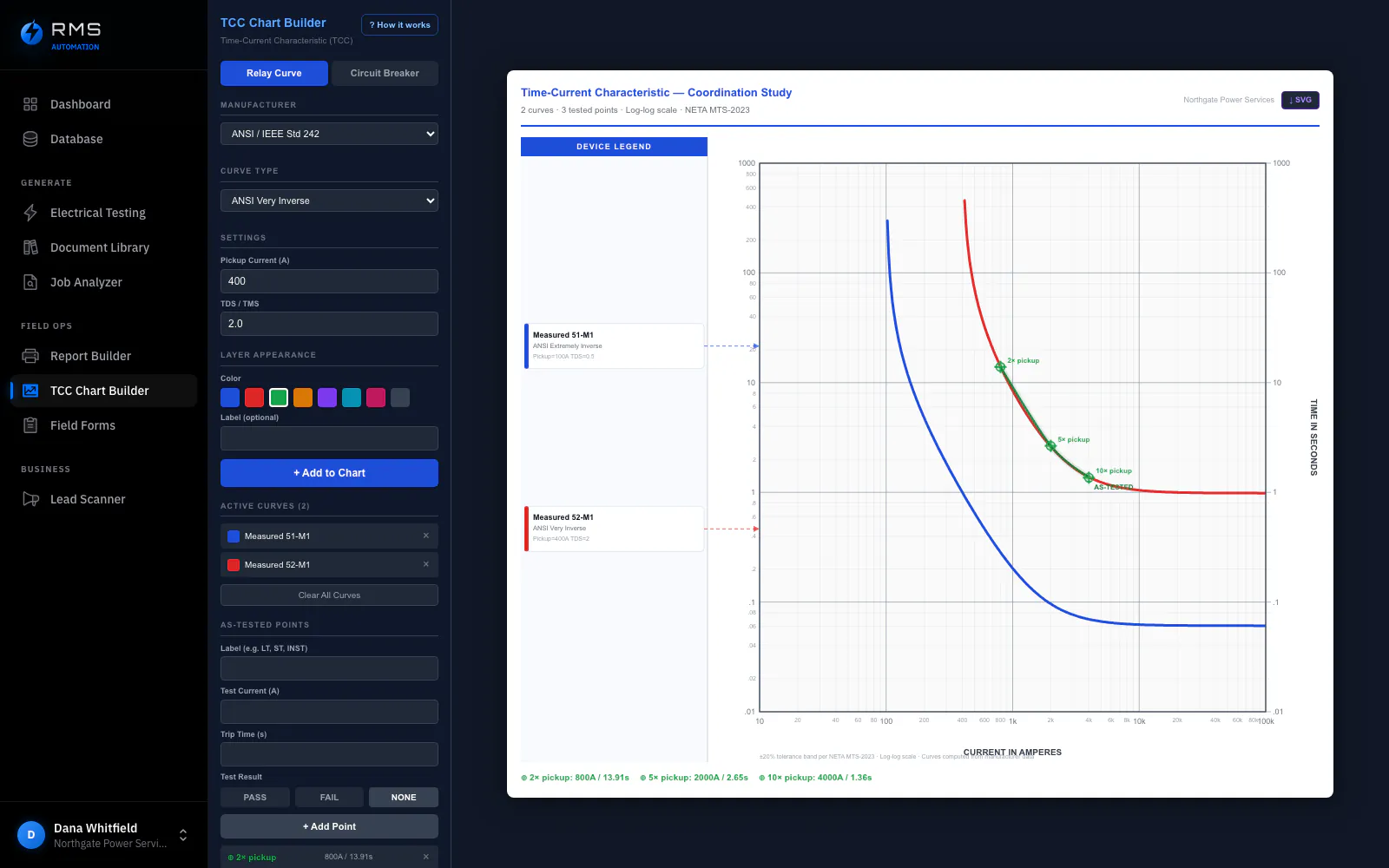
The TCC builder with two measured curves on the chart, 51-M1 and 52-M1, plotted on log-log axes of current in amperes against time in seconds. Three as-tested points are marked on the trace and a crosshair readout reads 800 A at 13.91 seconds for the two-times-pickup shot. The legend gives each curve its shape and settings (ANSI extremely inverse at 100 A pickup, TDS 0.5, and ANSI very inverse at 400 A pickup, TDS 2).
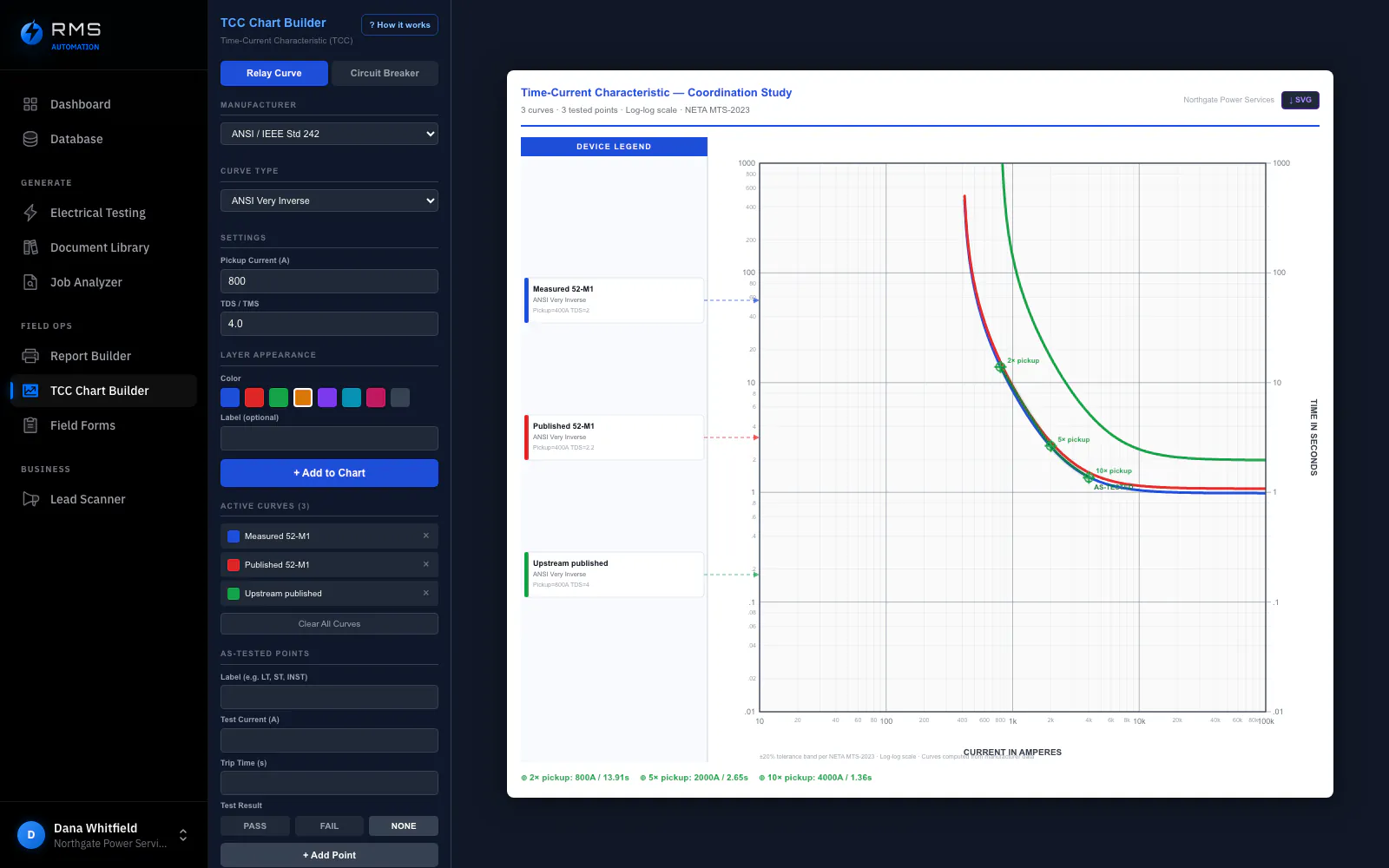
Three curves overlaid on one chart: the measured curve for 52-M1, the published curve for the same device, and the published curve for the device upstream of it. The legend separates them by settings (400 A pickup at TDS 2, 400 A pickup at TDS 2.2, and 800 A pickup at TDS 4) so the measured trace can be read against what the manufacturer’s data predicted and against the device it has to coordinate with.
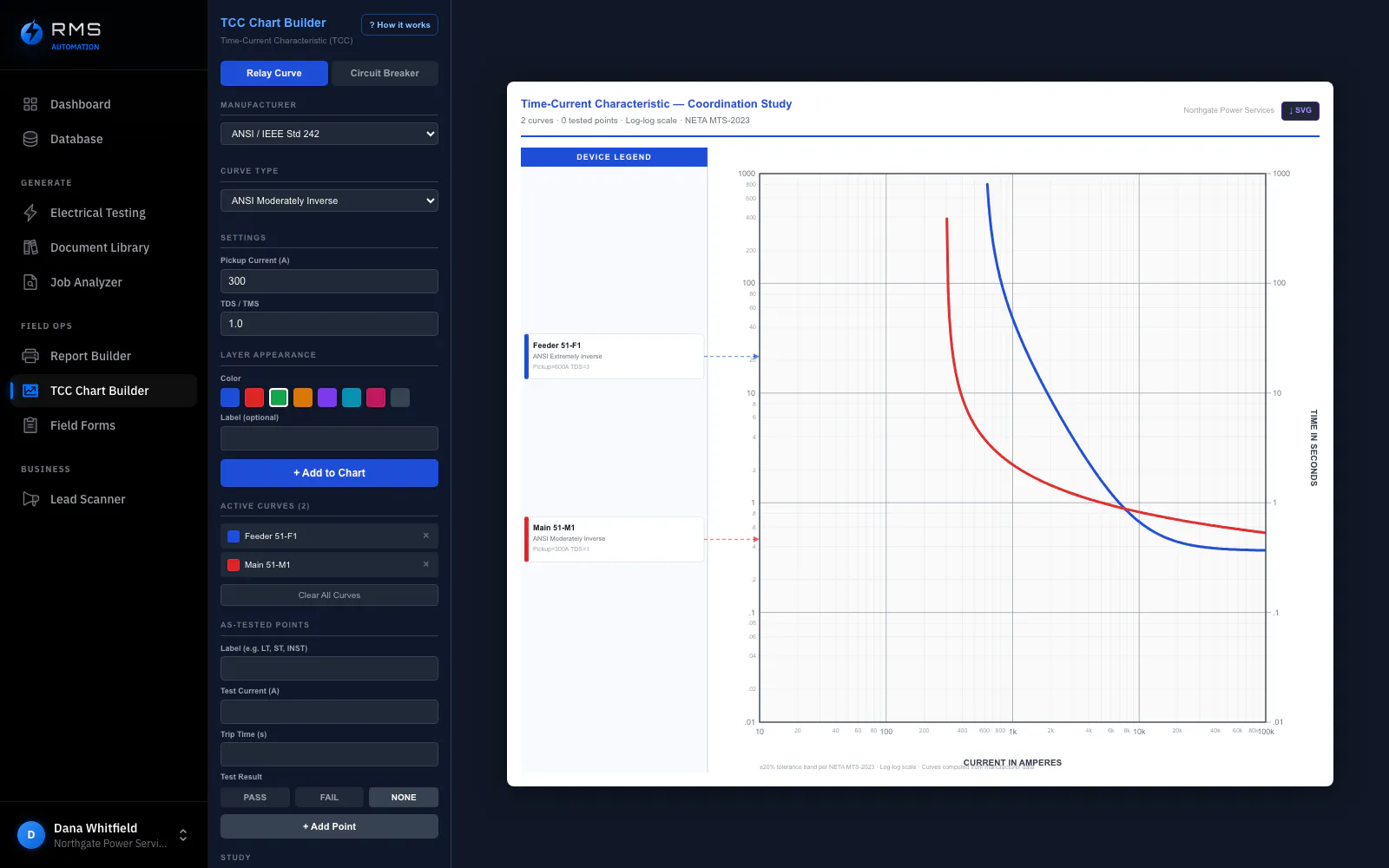
A feeder relay and the main relay above it drawn on the same log-log chart, 51-F1 set to 600 A pickup on an ANSI extremely inverse curve, 51-M1 set to 300 A pickup on an ANSI moderately inverse curve. No as-tested points have been added yet, so the chart shows only what the two devices are set to do relative to each other.

Document level

TCC coordination charts

  • Manufacturer curves plotted against your tested settings
  • Miscoordination visible before the report goes out, not after an outage
  • Exported into the report alongside the test data it belongs to
  • BasicIncluded
  • PremiumIncluded
  • UnlimitedIncluded
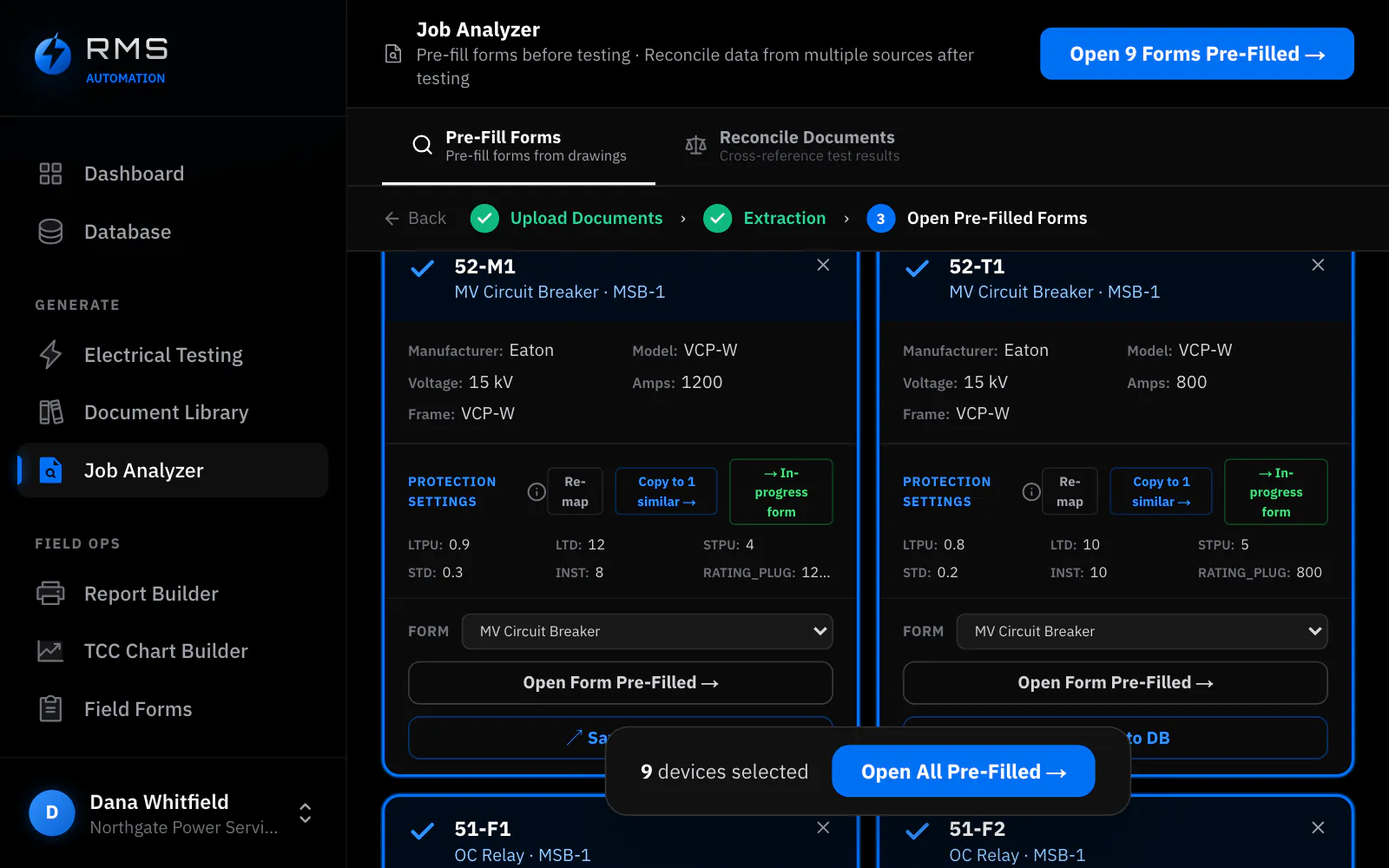
The extraction step of the Pre-Job Analyzer. A summary explains that nine protective devices were identified across the 15 kV main, two transformer primaries and the 480 V MCC lineups, and notes that the 2500 kVA transformer carries no trip unit of its own. Below, one card per device, 52-M1, an Eaton VCP-W medium-voltage breaker rated 15 kV and 1200 A, with its long-time and short-time pickup, delay and instantaneous settings read off the study, and controls to re-map a field, copy the settings to a similar device, or open the pre-filled form.
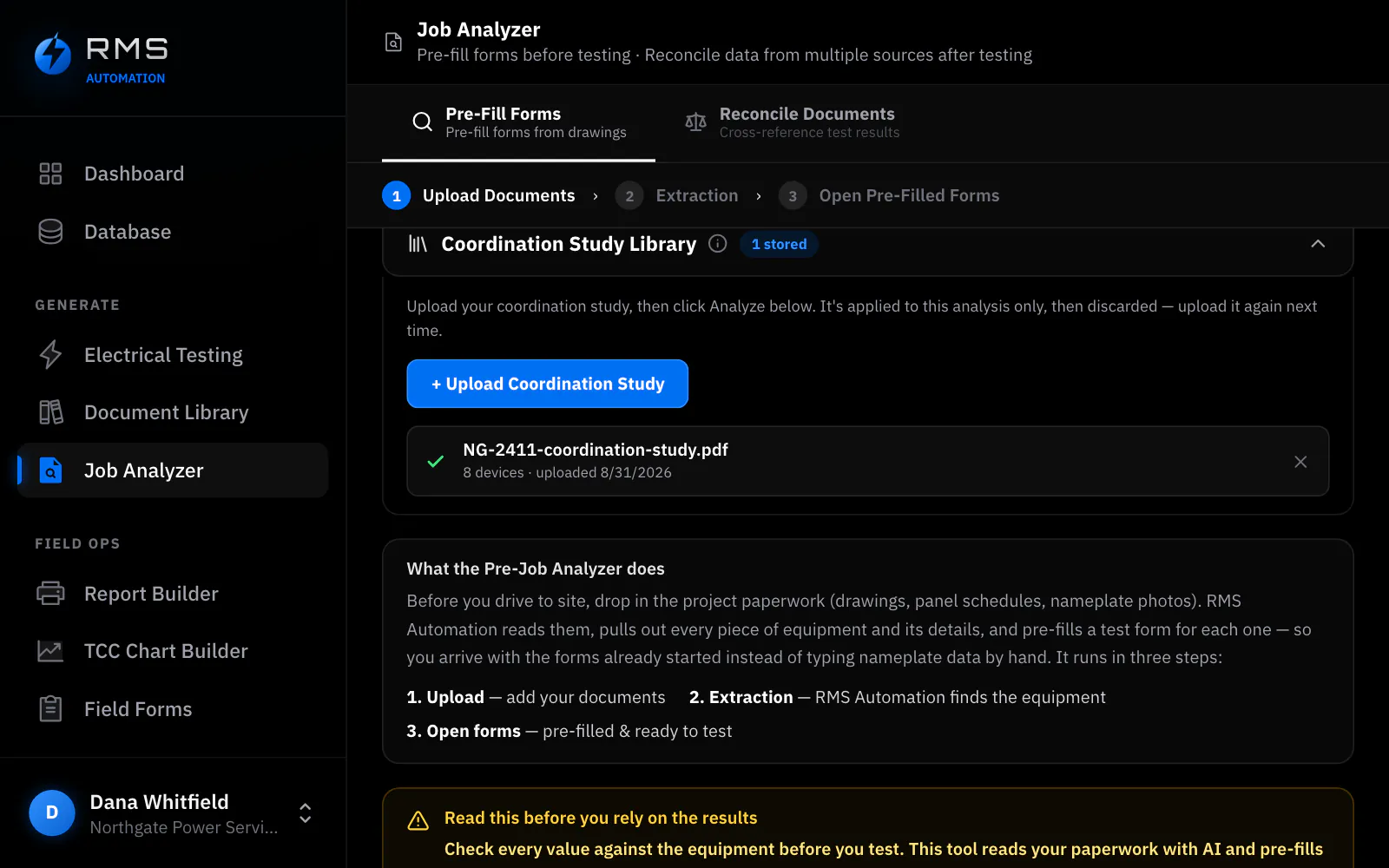
The upload step. A coordination study library holds one uploaded file (NG-2411-coordination-study.pdf, eight devices) with a note that the study is applied to this analysis only and then discarded. Beside it, the three-step explanation of what the analyzer does, and a plainly worded warning to check every value against the equipment before testing: the tool reads paperwork and saves typing, it does not verify anything in the field, and the person who signs the report remains responsible for it.
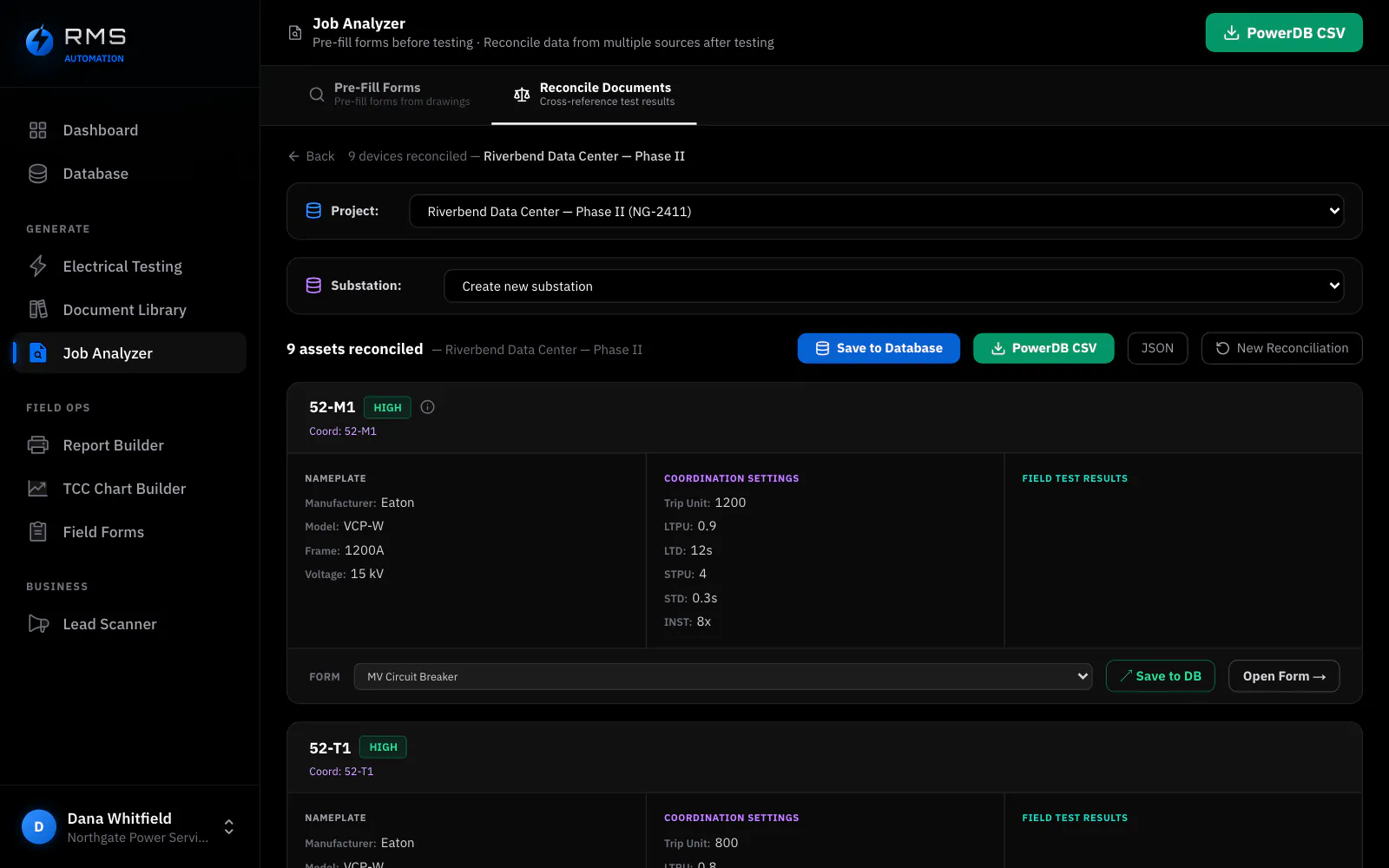
The reconciliation view: nine devices cross-referenced for the Riverbend Data Center Phase II project. Each device gets a row with its three sources side by side (the nameplate, the coordination study’s settings, and the field test results) so 52-M1 shows its Eaton VCP-W frame and voltage next to the trip settings the study specifies. Results can be saved back to the database or exported as JSON.

Job level

Pre-Job Analyzer

  • Ratings filled in from a nameplate photo instead of typed off a ladder
  • Coordination-study PDFs read for devices and trip settings
  • Test results reconciled against the drawing and the study afterwards, matched even when the sources spell the device differently
  • BasicNot included
  • PremiumIncluded
  • UnlimitedIncluded
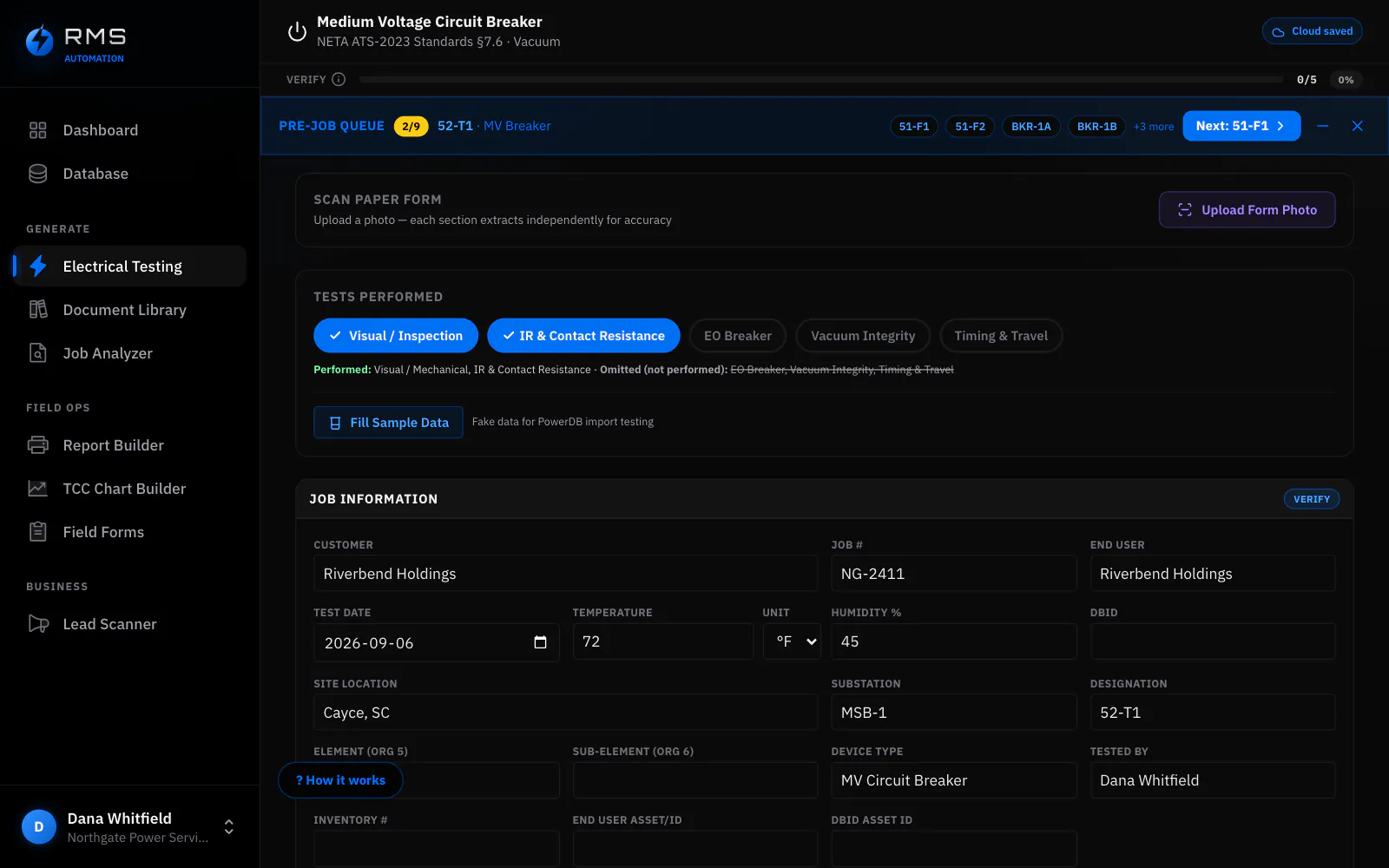
A breaker form with the pre-job queue pinned across the top of it: 52-T1, 51-F1, 51-F2, BKR-1A, BKR-1B and three more devices waiting behind the one being filled in, with the next device named. Below the queue, the paper-form scanner offers to read a photograph of a completed sheet section by section, then the tests-performed toggles record which tests were done and which were deliberately omitted.
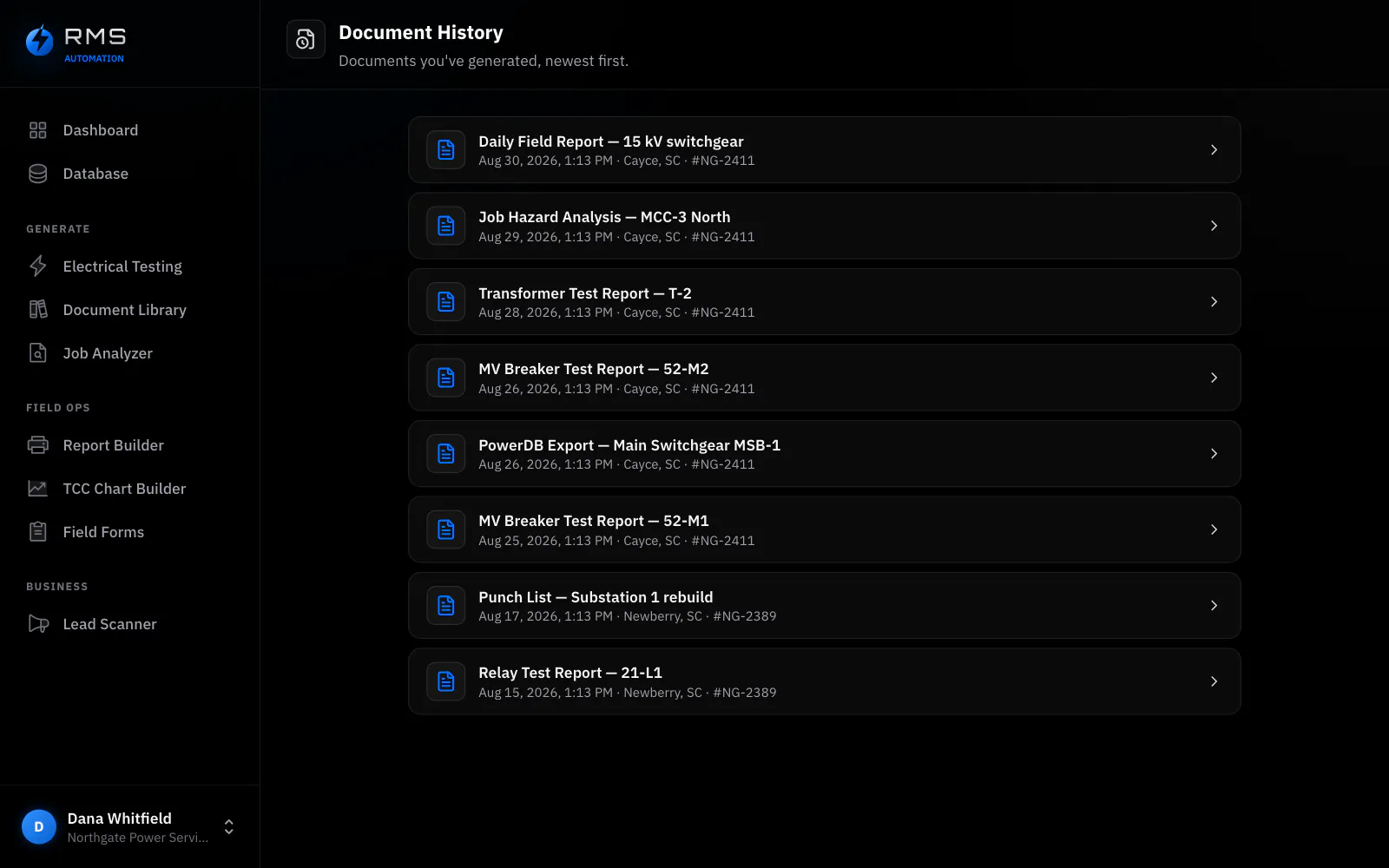
Document history, newest first: a daily field report for the 15 kV switchgear, a job hazard analysis for MCC-3 North, transformer and breaker test reports for T-2, 52-M2 and 52-M1, a PowerDB export for Main Switchgear MSB-1, a punch list and a relay test report. Each stamped with the date and time it was generated and tagged with its site and job number.
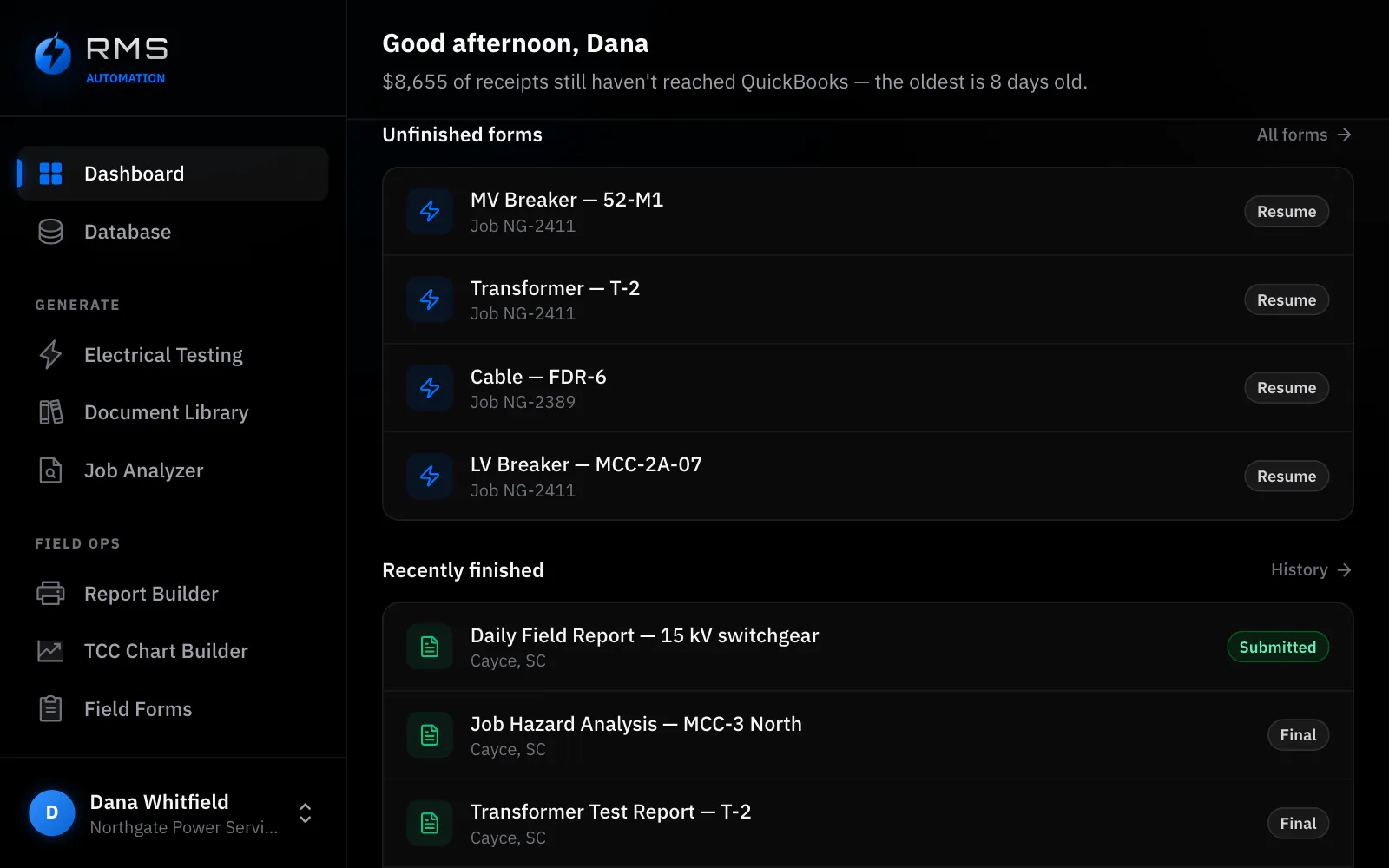
The dashboard’s unfinished-work panel. Four forms are listed mid-completion (an MV breaker on 52-M1 and a transformer on T-2 under job NG-2411, a cable run on FDR-6 and an LV breaker on MCC-2A-07 under NG-2389) each with a Resume control. Above them sit job cost cards showing hours logged, costs booked and the amount not yet in QuickBooks; below, the reports that were recently finished.

Job level

Multi-device jobs

  • Queue a whole lineup at once and work down it
  • Drafts sync to the cloud, so the tablet in the field and the laptop in the truck are the same job
  • Nothing lost when a device dies mid-shift
  • RMSConnect on the laptop finds every relay on the cables and the network, and says why a silent one will not answer
  • BasicNot included
  • PremiumIncluded
  • UnlimitedIncluded
Detail of a low-voltage breaker record in RMS Automation: insulation resistance readings pole-to-pole, pole-to-ground and line-to-load, each corrected to 20 degrees Celsius, above a contact resistance table in micro-ohms.
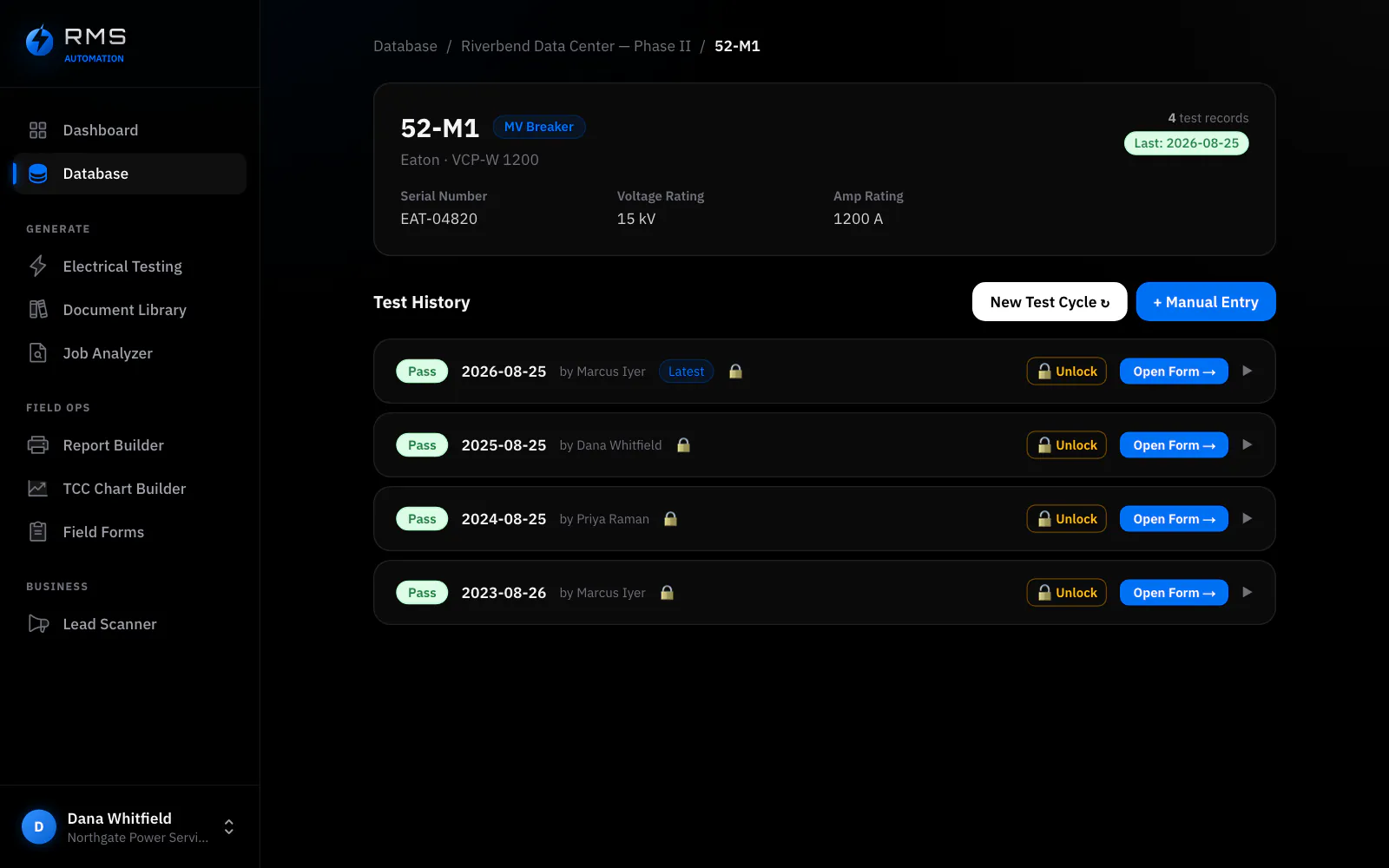
The record for a single device: 52-M1, an Eaton VCP-W 1200 medium-voltage breaker with serial EAT-04820, rated 15 kV and 1200 A, carrying four test records with the most recent dated 2026-08-25. Its test history lists one row per year back to 2023, each showing the result, who performed it, and a padlock marking the finalized records. The latest can be unlocked, or a new test cycle started.
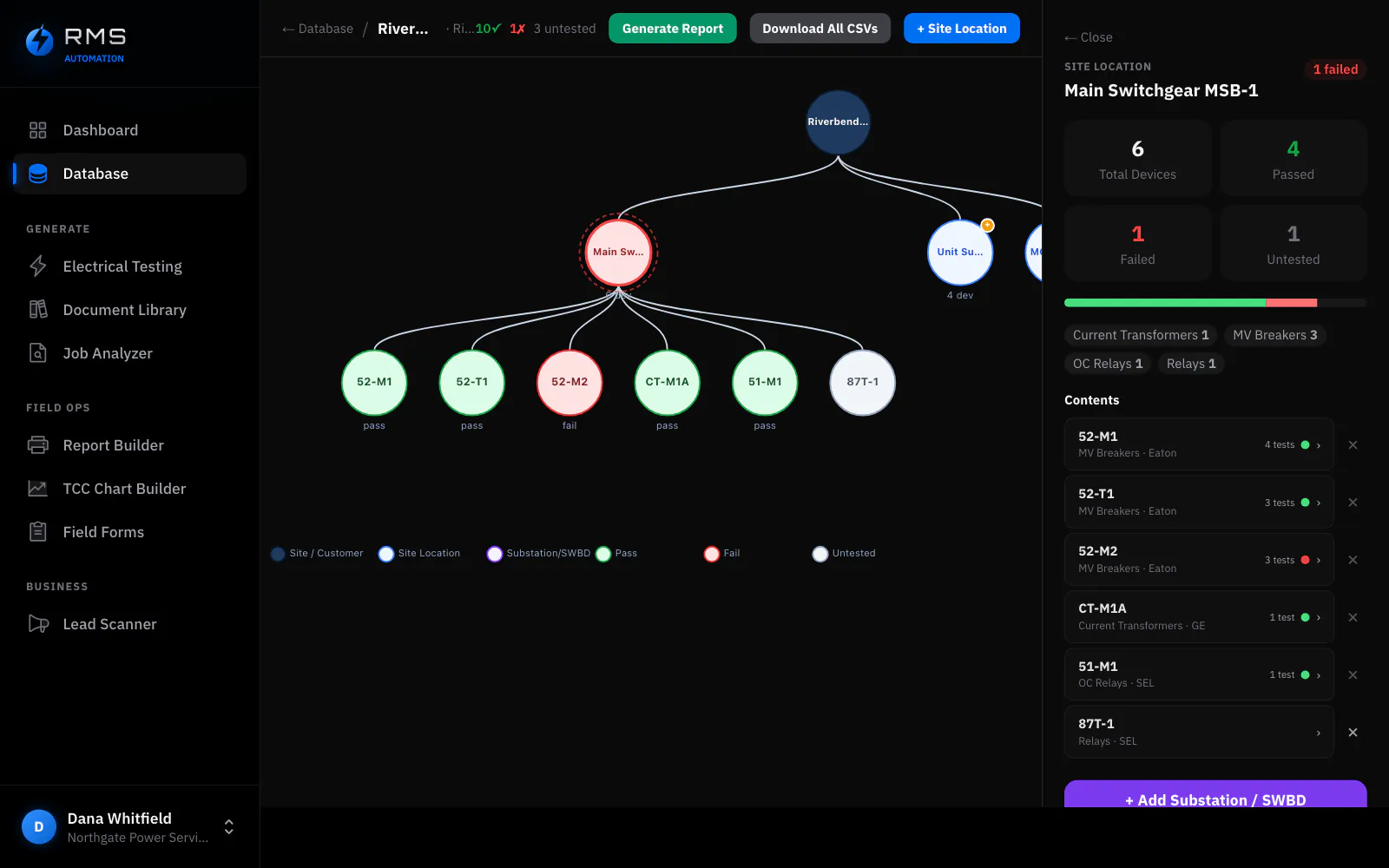
The Riverbend Data Center Phase II project opened out as a tree: site, then substation, then device. Ten devices have passed, one has failed and three are untested. Main Switchgear MSB-1 is expanded to its six devices, with 52-M2 marked failed among the passes, and a side panel breaks the substation down by device type: current transformers, MV breakers, overcurrent relays and relays.
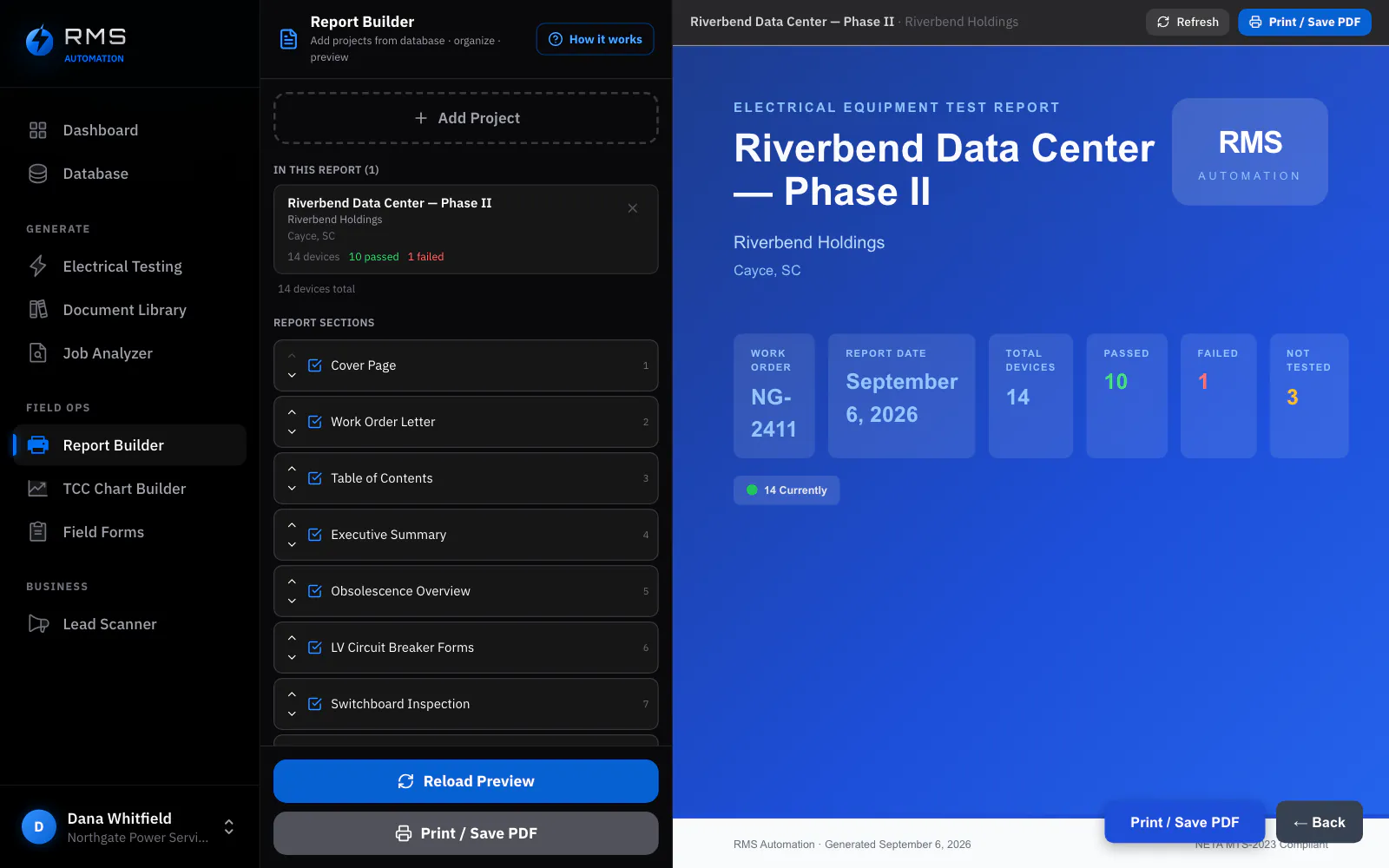
The report builder assembling one deliverable from the database. The Riverbend Data Center Phase II project has been added, contributing fourteen devices of which ten passed, and the report’s sections are listed in order, cover page, work order letter, table of contents, executive summary, obsolescence overview, the LV circuit breaker forms, switchboard inspection, deficiency summary and glossary, with a live preview and a print-to-PDF control.

Business level

Equipment Database

  • Full history per device, not per report
  • Finalize and lock, with an audit trail of what changed and when
  • Untested and failed devices surfaced per project and per substation, with no list to maintain
  • Yours to export in full, at any time, in a format you can read without us
  • BasicNot included
  • PremiumNot included
  • UnlimitedIncluded
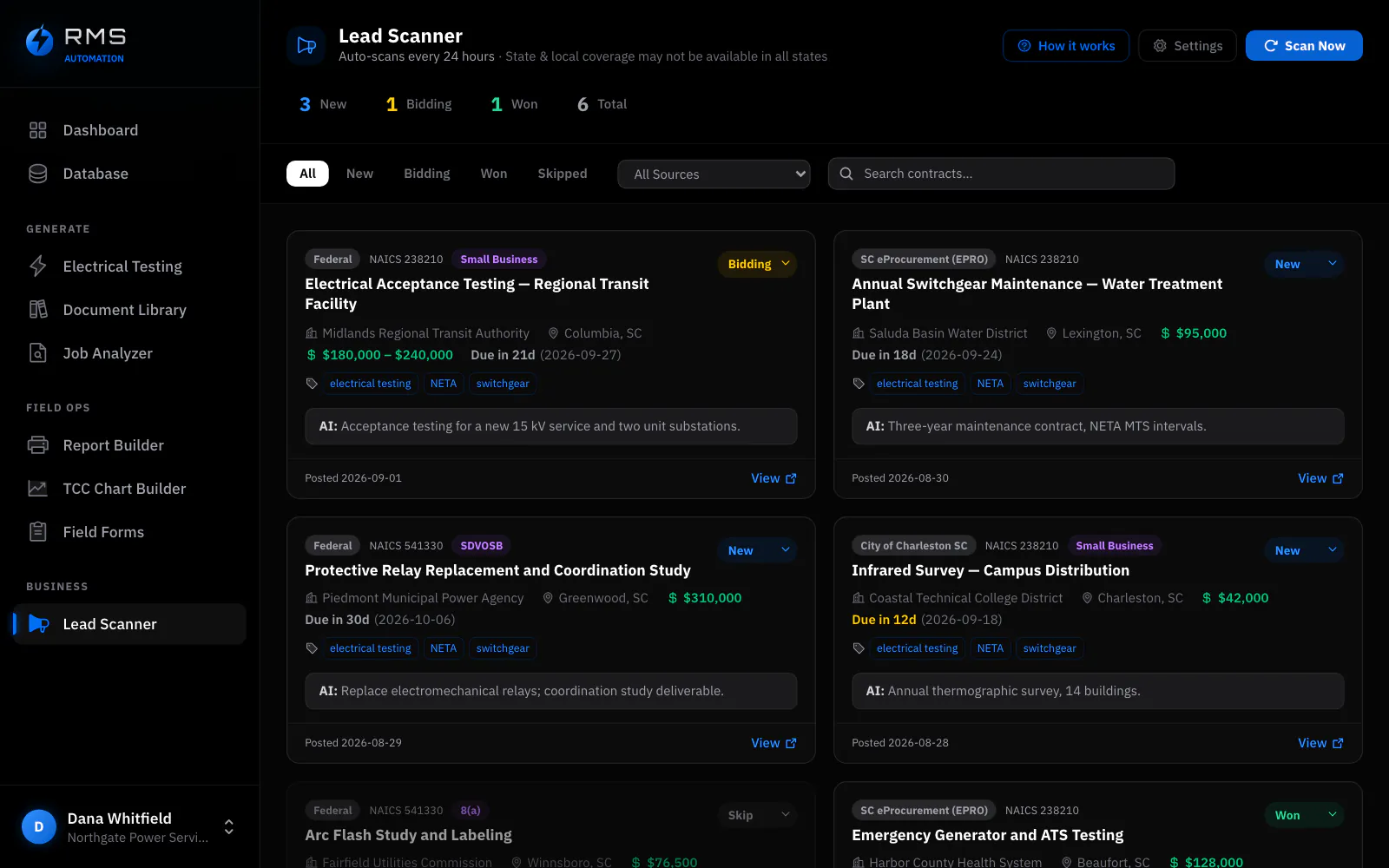
Six solicitations found across different sources, each card tagged with where it came from (Federal, SC eProcurement, City of Charleston) along with its NAICS code and any set-aside it carries, such as small business, SDVOSB or 8(a). They run from a $180,000–$240,000 acceptance testing job for a regional transit authority through relay replacement, an infrared survey, an arc flash study and generator testing, each with its agency, city, value and days remaining.
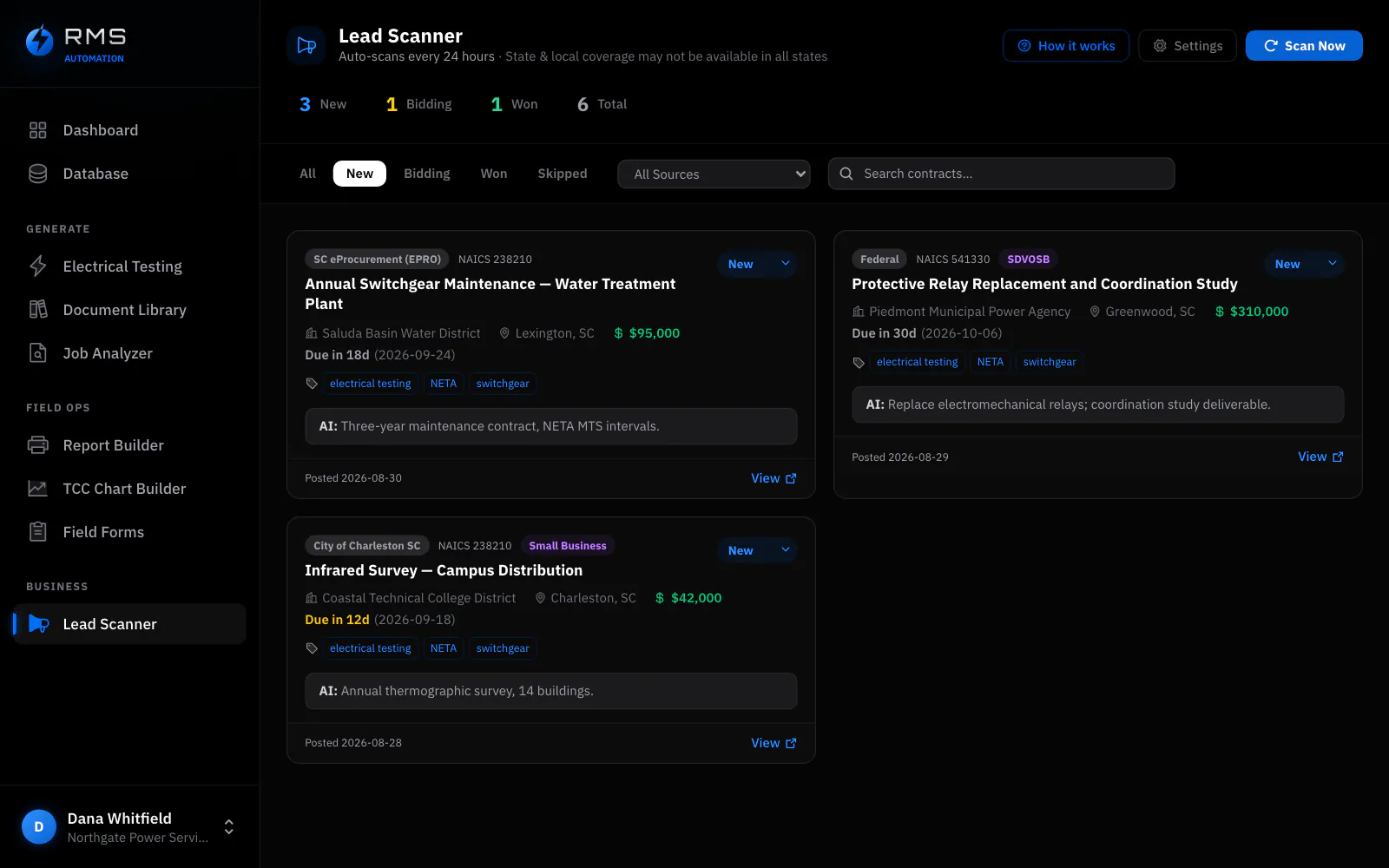
The same list read one line at a time. Under each solicitation sits a one-sentence summary of what the job actually is: a three-year maintenance contract on NETA MTS intervals, a relay replacement with a coordination study as the deliverable, an annual thermographic survey of fourteen buildings: beside the tags, the closing date and the link out to the original posting.
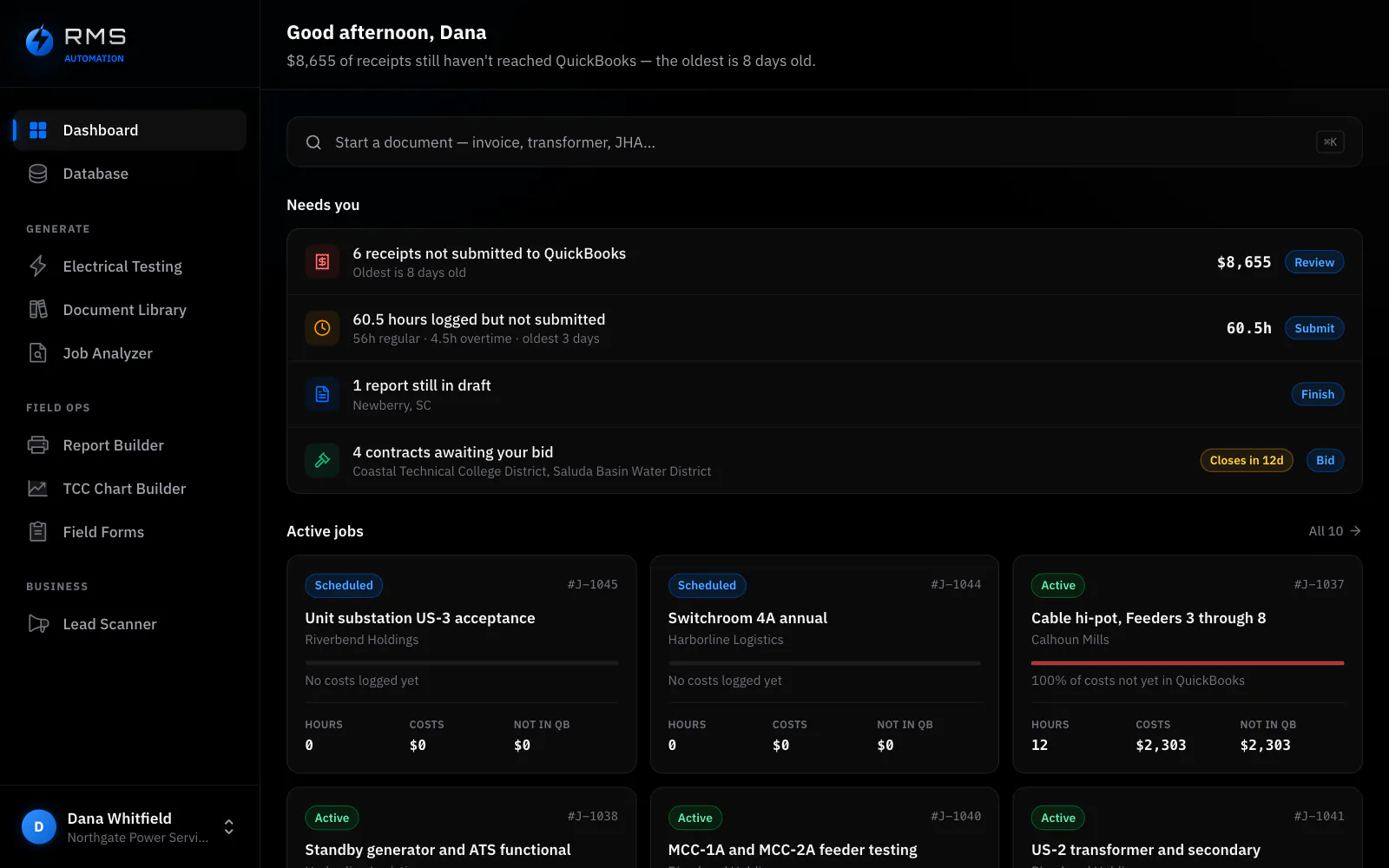
The dashboard opening on a “Needs you” list: $8,655 of receipts that have not reached QuickBooks with the oldest eight days old, 60.5 hours logged but not submitted, one report still in draft, and four contracts awaiting a bid with the nearest closing in twelve days. Each with the one control that clears it. Below sit the active job cards with their hours, costs and QuickBooks status.

Business level

Lead Scanner

  • Solicitations filtered to electrical testing and to your area
  • AI summaries of the contract, so you know whether to read it before you read it
  • Checked daily, not when somebody remembers
  • BasicNot included
  • PremiumNot included
  • UnlimitedIncluded