The form is not the safety system. It should stop pretending to be.
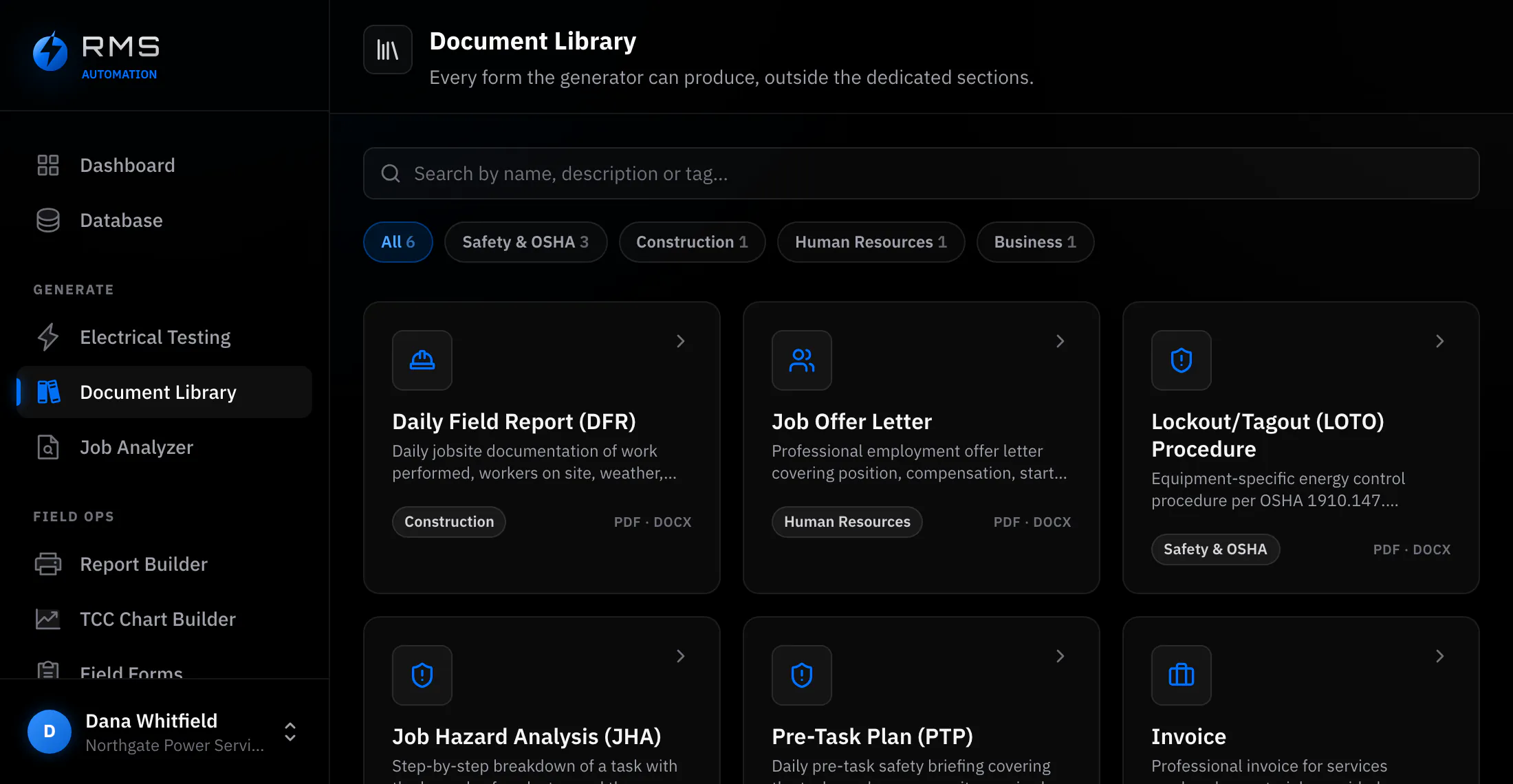
A JHA, a LOTO plan and a pre-task plan are documents whose whole value is in the thinking that goes into them, and most of the tools that produce them compete on how much of that thinking they can skip. That is the wrong axis. What is actually worth automating is the shape of the document: the columns that must exist, the sources that must be listed, the steps that must be in order.
- Six documents
- JHA, LOTO and PTP on the safety side; invoice, daily field report and offer letter on the business side.
- Basic
- The lowest plan that includes it. In every plan above it too.
- Yours to assess
- Nothing is pre-filled and nothing is guessed. The hazard judgement stays with the qualified person on site.
A hazard analysis about this job, not about testing in general
A job hazard analysis written against a generic template lists the hazards of the category, gets signed, and teaches the crew that the form is a formality. That is the failure mode worth designing against, not the time it takes.
So this gives you the structure, and nothing else: a row per task step, each with its own hazards, controls and PPE, because the hazard of racking a breaker out is not the hazard of taking readings on it. The rows open empty, deliberately. A form that guesses the assessment has answered the only question worth asking. The lockout plan applies the same principle one level deeper.
- A row per task step, each with its own hazards, controls and PPE
- Sixteen-item PPE checklist and a crew acknowledgment block on the same document
- Nothing pre-filled and nothing guessed. The assessment is the qualified person's
- Prints to OSHA-shaped output with ruled signature lines for the crew
Pre-task plans that are cheap enough to reissue
The pre-task plan has the shortest useful life on site: it is written for a shift and is wrong the moment scope moves. On paper, rewriting it costs twenty minutes and a clipboard, so mostly it is not rewritten. Here it costs a few edits and a reprint. A plan that is cheap to reissue is a plan that gets reissued.
The permit block is on the sheet (electrical, confined space, hot work, excavation, work at height) alongside the PPE list and a hazard-and-controls section, so the tailgate conversation has an order to follow rather than a blank page.
- Permit-required work, PPE and hazard controls on one sheet, in briefing order
- Task, work area, supervisor and crew captured for the shift it covers
- Emergency information (contact, hospital, muster point) carried on the plan itself
- Crew acknowledgment lines printed for signature at the tailgate
Invoices and field reports on your letterhead
The same idea applied to the side of the work that gets billed: an invoice with line items, categories, quantities, rates and tax; a daily field report with crew, hours, work performed and site conditions. Both are usually a spreadsheet somebody keeps reformatting.
What comes out is a typeset PDF under your company's name and nobody else's. No RMS Automation logo, no “generated with” line and no watermark anywhere on a document a client sees.
- Invoice with line items, categories, quantities, rates, tax and totals
- Daily field report covering crew, hours, work performed and conditions
- Your company name, address and terms in the letterhead: unbranded by us, entirely
- Typeset for print at letter size, not a spreadsheet exported sideways
A lockout plan that names every source, not the obvious one
The switchgear cell that kills someone is almost never the one nobody de-energised. It is the one where the 15 kV feed was racked out and locked correctly and the control power transformer feeding the cell from somewhere else was not, or the closing spring was still charged. A sheet that lists a single source documents the part everybody already remembered.
So the procedure is a table with a row per energy source, and each row carries all four things that make it a plan: where the source is, what magnitude it is at, how it is isolated, and how you prove it is dead. It follows OSHA 29 CFR 1910.147 and prints with ruled signature blocks for the authorised worker, the supervisor and the return to service.
- One row per energy source, electrical, control power, stored spring, whatever else is in the cell
- Isolation method and verification method recorded per source, not once for the job
- Lock application log: device, location, lock number, who applied it
- Stored-energy release and zero-energy verification as explicit steps
- Return-to-service section completed after the work, on the same sheet
What it saves, and how to work it out
Not measured customer results. Every input below is an assumption, shown so you can replace it with your own figures.
No saving is claimed on the hazard assessment itself. Every line below is document handling. Thinking about what could go wrong on this job should take exactly as long as it takes.
| Line | Value |
|---|---|
| Documents in a job's safety and billing pack (assumed) | JHA · LOTO · PTP · invoice |
| Producing the pack from Word and Excel templates (assumed) | 35 min |
| Filling the same four here, then reading them (assumed) | 15 min |
| Jobs per week (assumed) | 3 |
| Loaded labour rate (assumed) | $95 / hr |
| Saved per job | 20 min · $32 |
| Saved over a year at three jobs a week | 52 hr · $4,940 |
Fifteen minutes and not five, because you are still filling these in: what is gone is the layout, not the thinking. The cost never in a table like this is the document you cannot produce when an insurer or an inspector asks for the signed JHA from a job eighteen months ago.
Who it changes the day for
The paperwork stops being the reason not to
On a small crew the safety pack competes with the work and loses quietly, not by being skipped, but by being done at the end of the week for the whole week. What moves the needle is friction: a form that opens into the right structure on a phone in a truck gets filled at the tailgate; a Word template on an office laptop gets filled on Friday.
Evidence that exists without being chased
At scale the question is never whether the crews are working safely; it is whether you can demonstrate it. A programme evidenced by paper in trucks is real on site and invisible from head office. Forty testers working from one set of forms produce forty documents with the same columns in the same order. The precondition for reviewing them at all. Templates on individual laptops drift within a quarter.