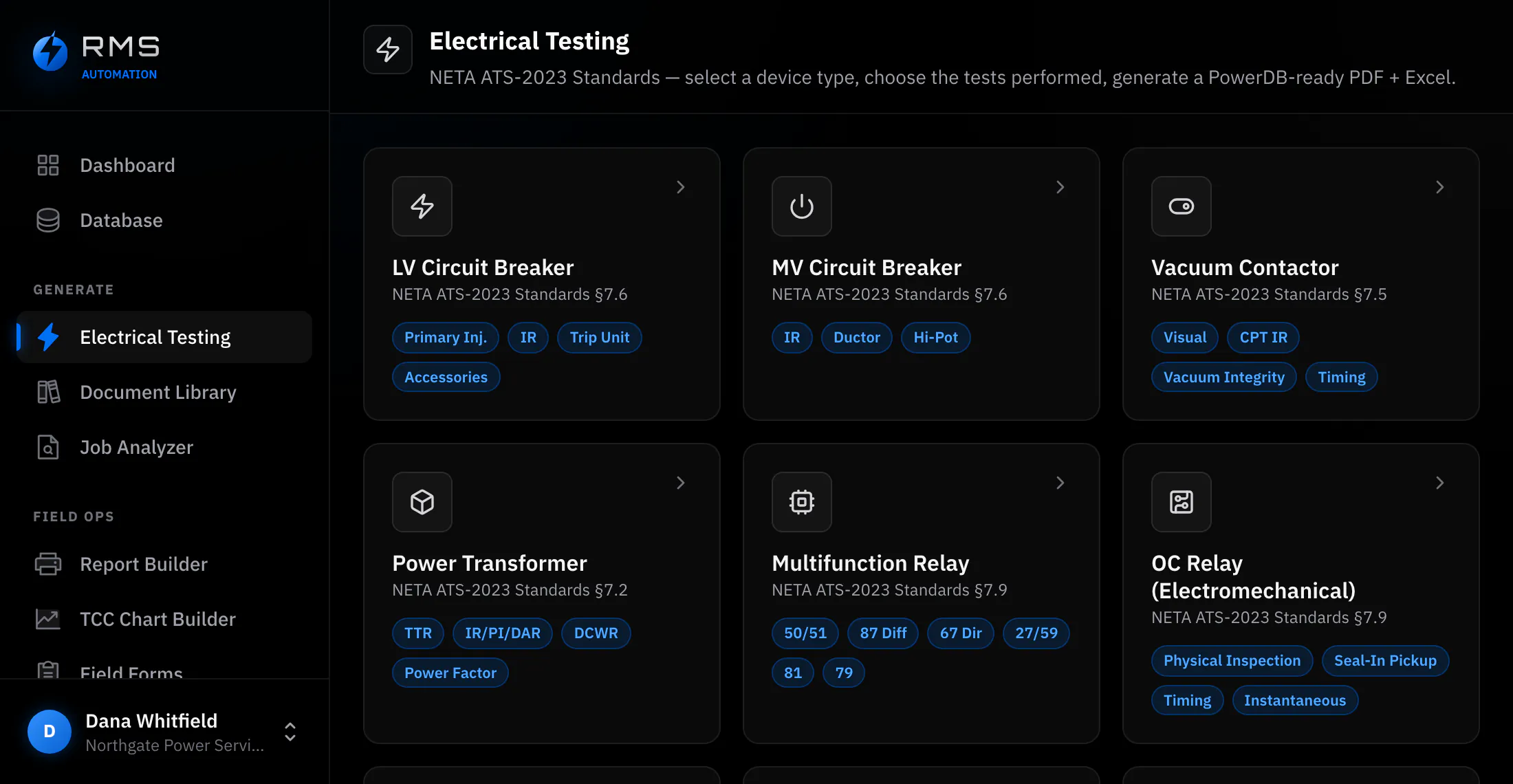
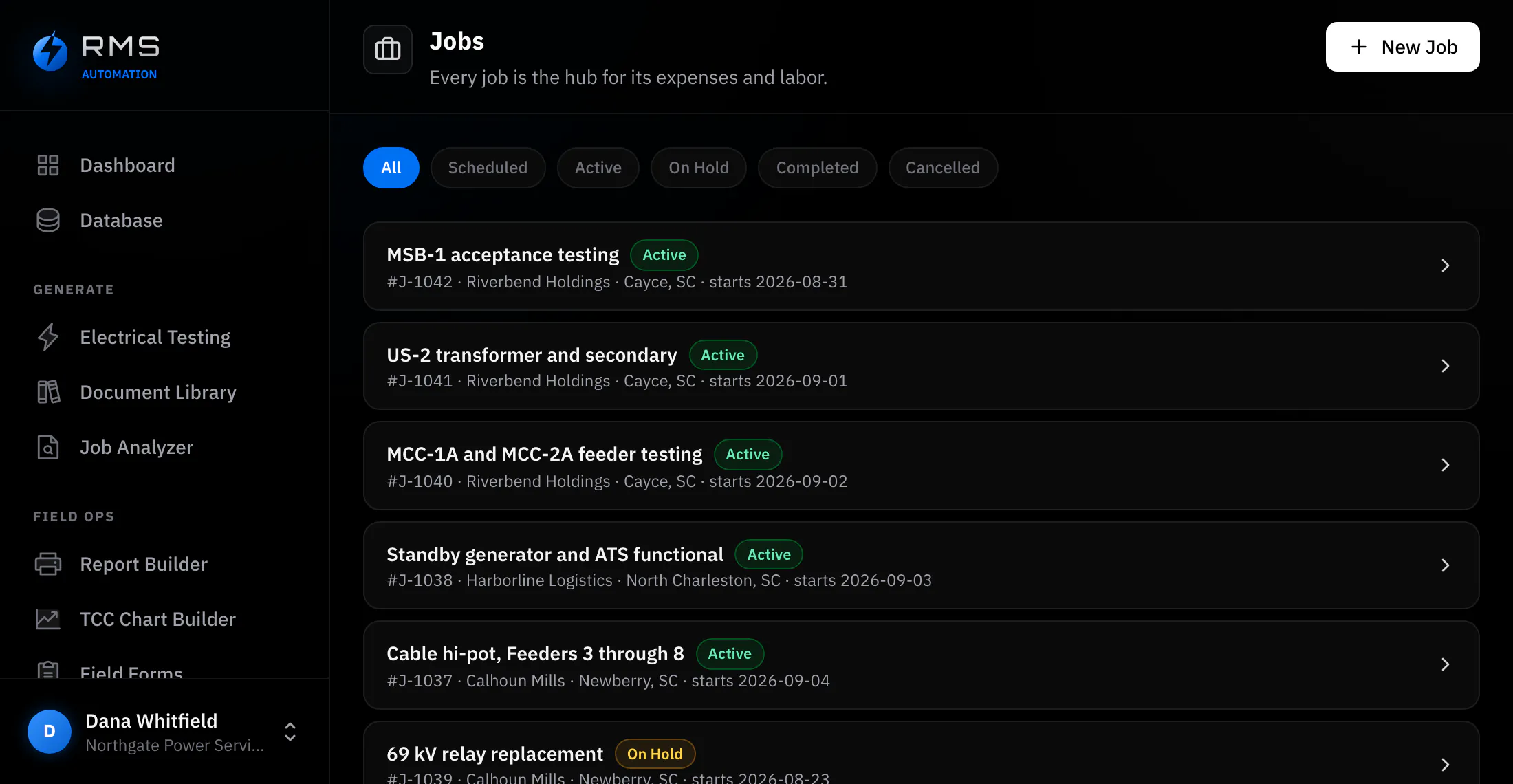
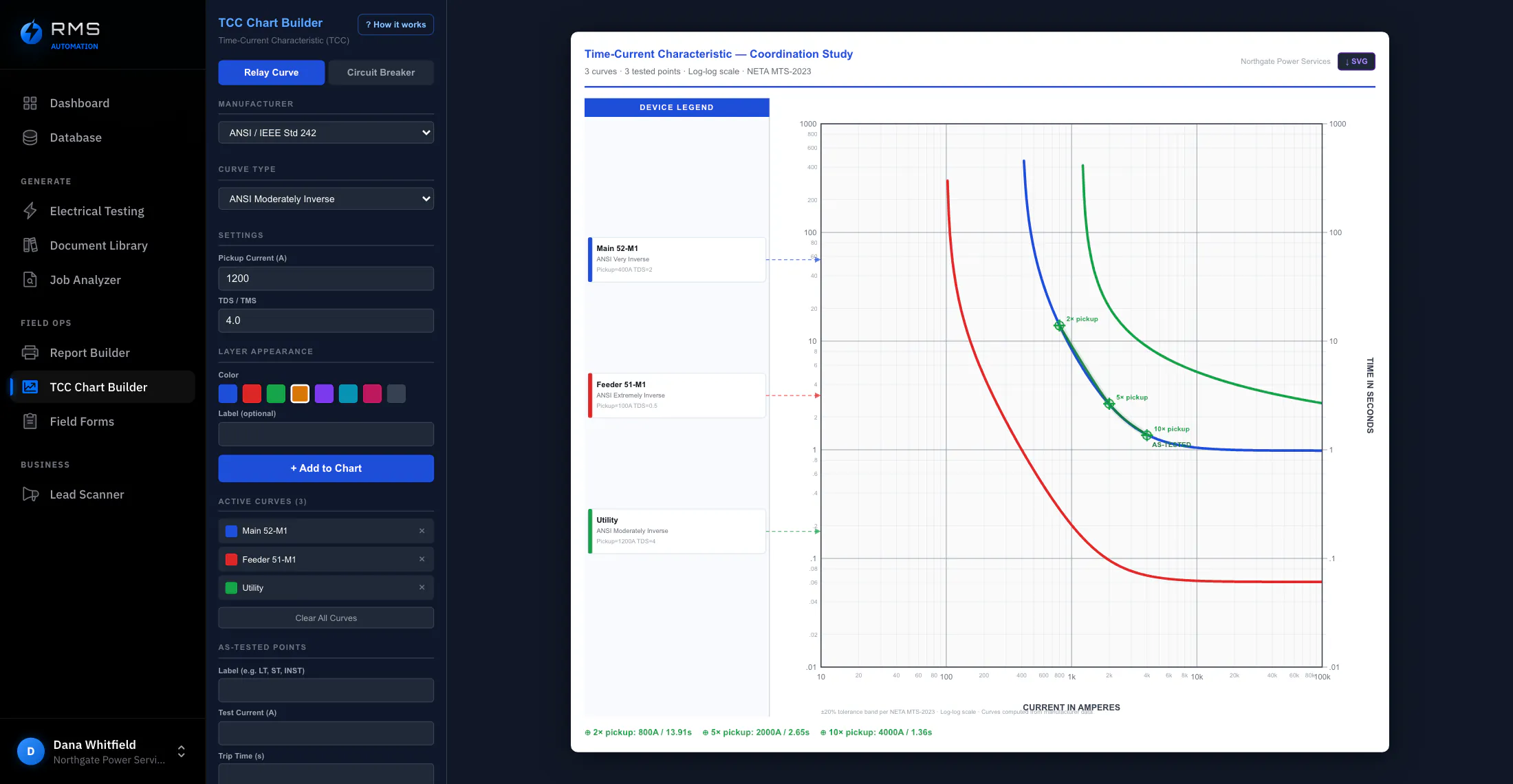
A report is a snapshot. A breaker has a life.
Test data is almost always stored the way it was delivered: as reports, in folders, by job. That arrangement answers “what did we do in March” perfectly and cannot answer “what has this breaker been doing for six years” at all, which is the only question that predicts anything.
- Per device
- History organised by the equipment, not by the report it arrived in.
- Unlimited
- The plan that includes it.
- Yours to take
- Full export, any time, in formats readable without us. No request, no fee.
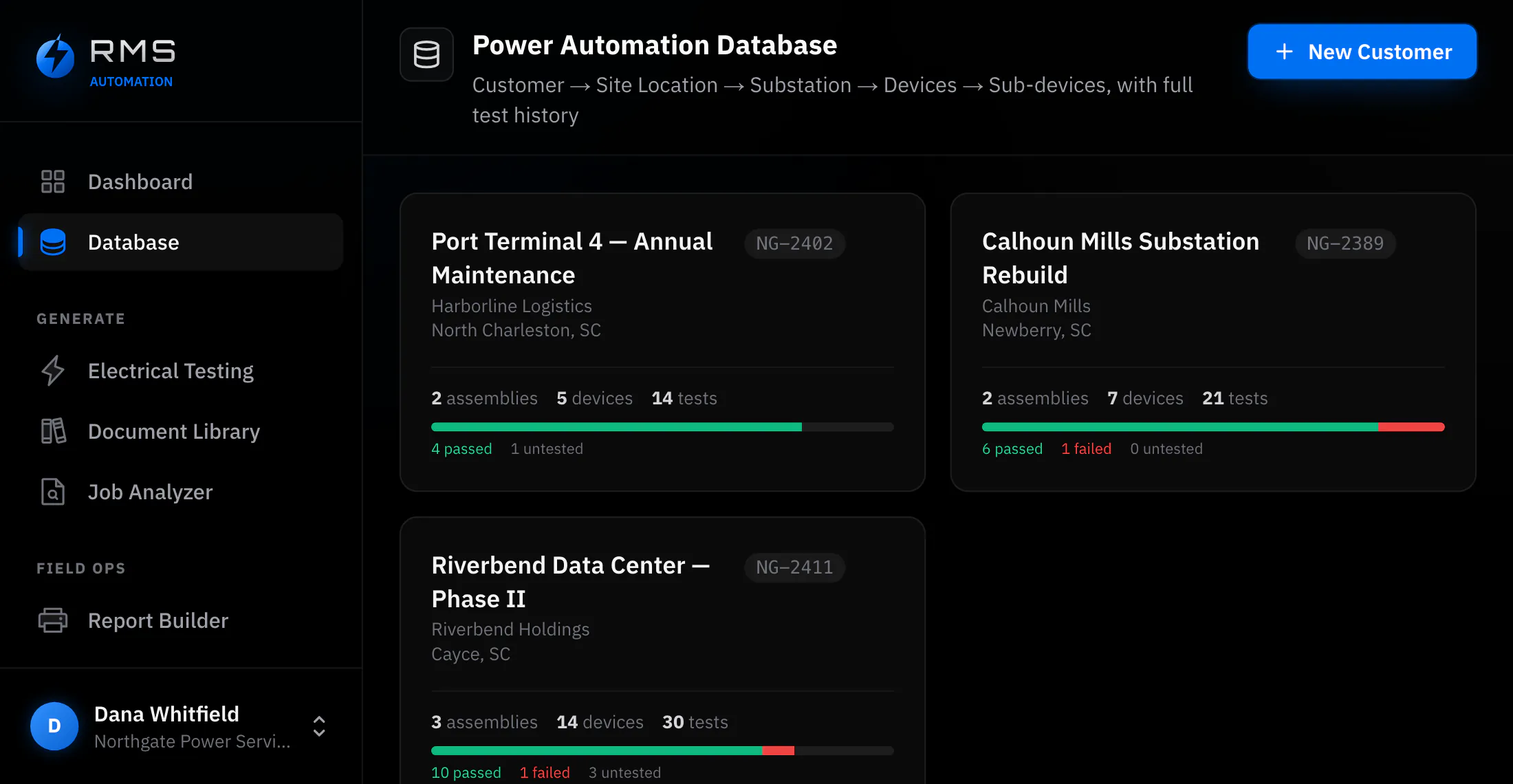
Every test a device has had, in order
Customer, site, switchgear, device, and at the end of that chain a record that outlives every job that touched it.
A single insulation resistance reading is almost meaningless on its own: a number against a limit that passes or does not. The same reading as the sixth in a series that has been sliding for four years is what tells you to act before the failure rather than after it.
- History per device, spanning every job, crew and year
- Every reading kept corrected and raw, so a comparison across years is of the equipment and not of the weather
- Every cycle opens back into the form that produced it
- Equipment that moves site takes its history with it
Finalize, lock, and keep the trail
There is a moment when a record stops being working data and becomes evidence. Finalizing locks it, and the lock is enforced at the server rather than in the interface: a locked cycle refuses edits and refuses deletion. Reopening one is a separate, deliberate act.
A locked cycle is never written over. A re-test (or an import carrying new values) opens a new cycle alongside the old one, so the history gains a row instead of losing one. What you cannot show is a field-by-field diff of an edit made before the lock: while a cycle is unlocked, edits overwrite what was there and the protection begins at the finalize. Tamper-evident signing of every change is an Enterprise capability.
- Explicit finalize step, so “draft” and “issued” are different states
- The lock refuses edits and deletes at the server, not merely in the interface
- Re-tests and re-imports open a new cycle rather than overwriting the finalized one
- Every cycle carries its test date and the technician it belongs to
What got missed, before somebody asks
The gap on a lineup is rarely the device that failed. It is the device nobody got to: the cubicle locked out that morning, the one behind the scaffold. It goes unnoticed because a device with no result looks exactly like a device nobody has written up yet.
Coverage is counted from the records themselves, so the gap list is a consequence of the data rather than a document somebody maintains.
- Passed, failed and untested counted per project and at every level of the tree
- Untested kept distinct from failed, because they are different problems
- Every device carries the date it was last tested and who did it
It is your data, and you can take it
A database of your test history is exactly the kind of asset that gets used to make leaving difficult. So, plainly: full export, at any time, in formats you can read without us. Not a filtered subset, not a support ticket, not a fee, not a thirty-day window after cancellation. Device records, readings raw and corrected, history, attached photographs and the audit trail, as CSV and PDF, in a structure documented well enough that a competitor could import it.
We would rather you stayed because the product is worth paying for. A retention strategy built on hostage-taking is a bet that it is not.
- Everything, not a report of everything, including photographs and the audit trail
- Self-service, immediate, unlimited, at no cost
- Open formats with a documented structure
- Available while you are cancelling, not only before you decide to
What it saves, and how to work it out
Not measured customer results. Every input below is an assumption, shown so you can replace it with your own figures.
| Line | Value |
|---|---|
| Times a year somebody needs a device's last result (assumed) | 50 |
| Finding it in folders, emails and old PDFs (assumed) | 25 min |
| Opening the device record (assumed) | 1 min |
| Loaded labour rate (assumed) | $95 / hr |
| One re-visit avoided by catching an overdue device (assumed) | 2 techs · 1 day |
| Saved on retrieval alone, per year | 20 hr · $1,900 |
| With the avoided re-visit | 36 hr · $3,420 |
Neither is the real number. The real number is the failure you saw coming: and the trend is the only mechanism by which you get to see it early.
Who it changes the day for
It turns one job into a relationship
A contractor who tested a site three years ago and can, today, open the breaker's history is not quoting against three other firms. They are the firm that already knows the site. And when a client asks what is due, the answer is a list rather than a weekend spent reading your own old reports.
The asset picture stops living in people
Across a portfolio, equipment knowledge is usually held by whoever has been there longest, and it leaves with them. History held per device is institutional rather than personal: it supports fleet-level questions no individual can answer (which models fail early, which sites run hot) and it is the substrate an audit or a client pre-qualification actually needs.