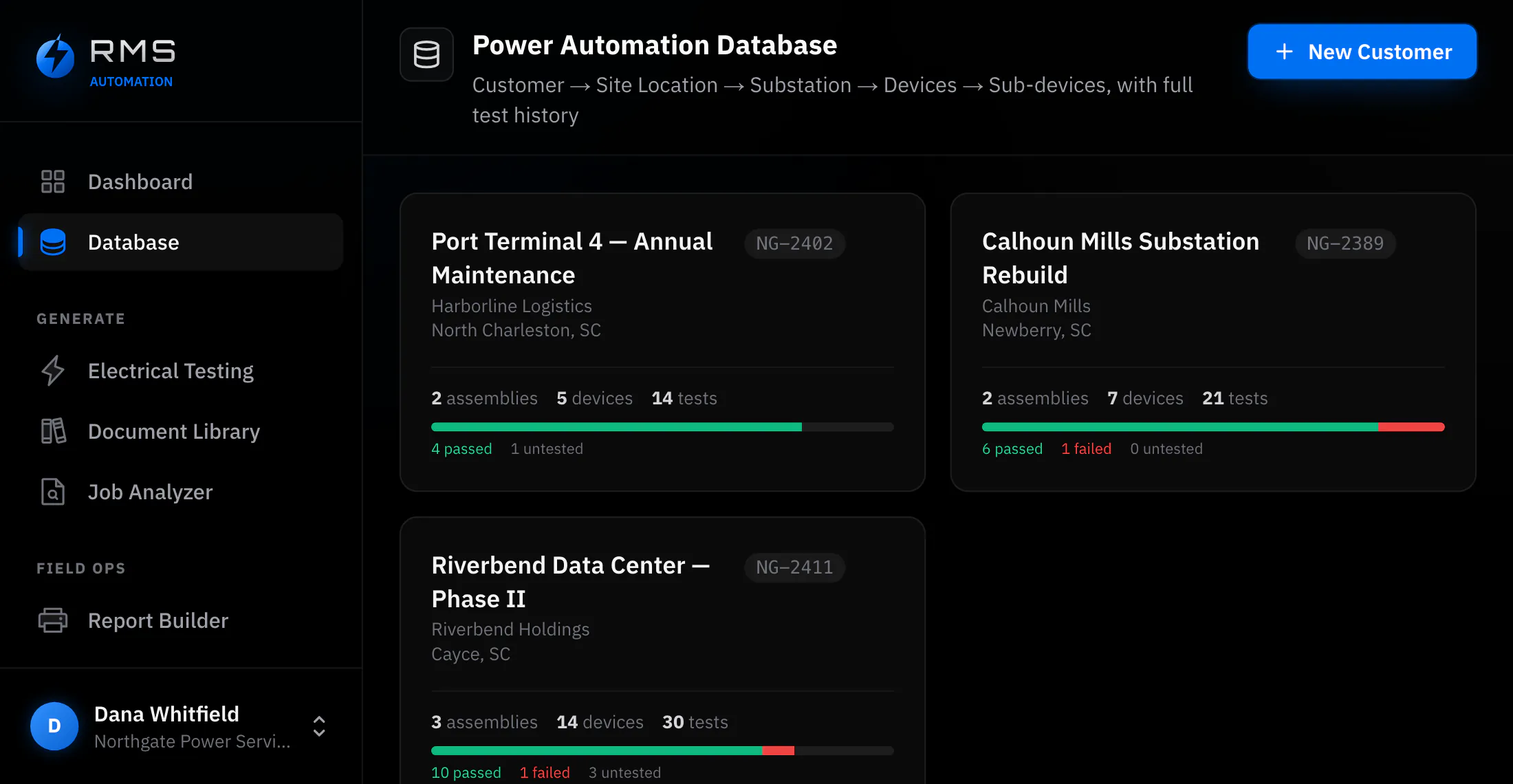
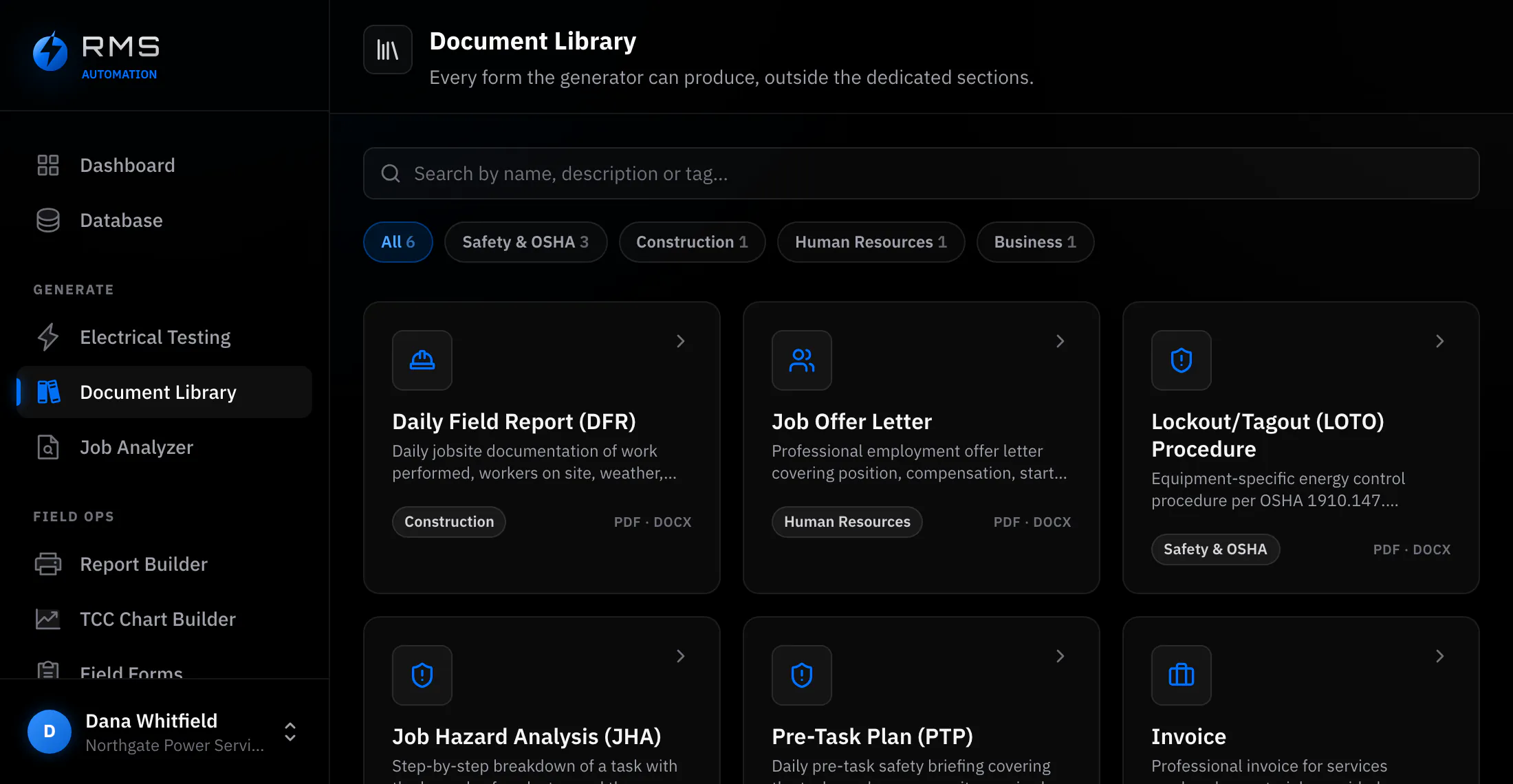
The work is published. Nobody has time to go and look.
Public electrical testing work is advertised, openly, on portals anyone can read. It is also spread across a federal system, a state system and a different municipal system per county, each with its own search that does not understand what you do, which is why most of it is found by firms who happened to look on the right evening.
- Checked daily
- Not when somebody remembers, and not the week before a deadline.
- Unlimited
- The plan that includes it.
- Filtered to you
- Electrical testing scope, in your area, at sizes you can actually staff.
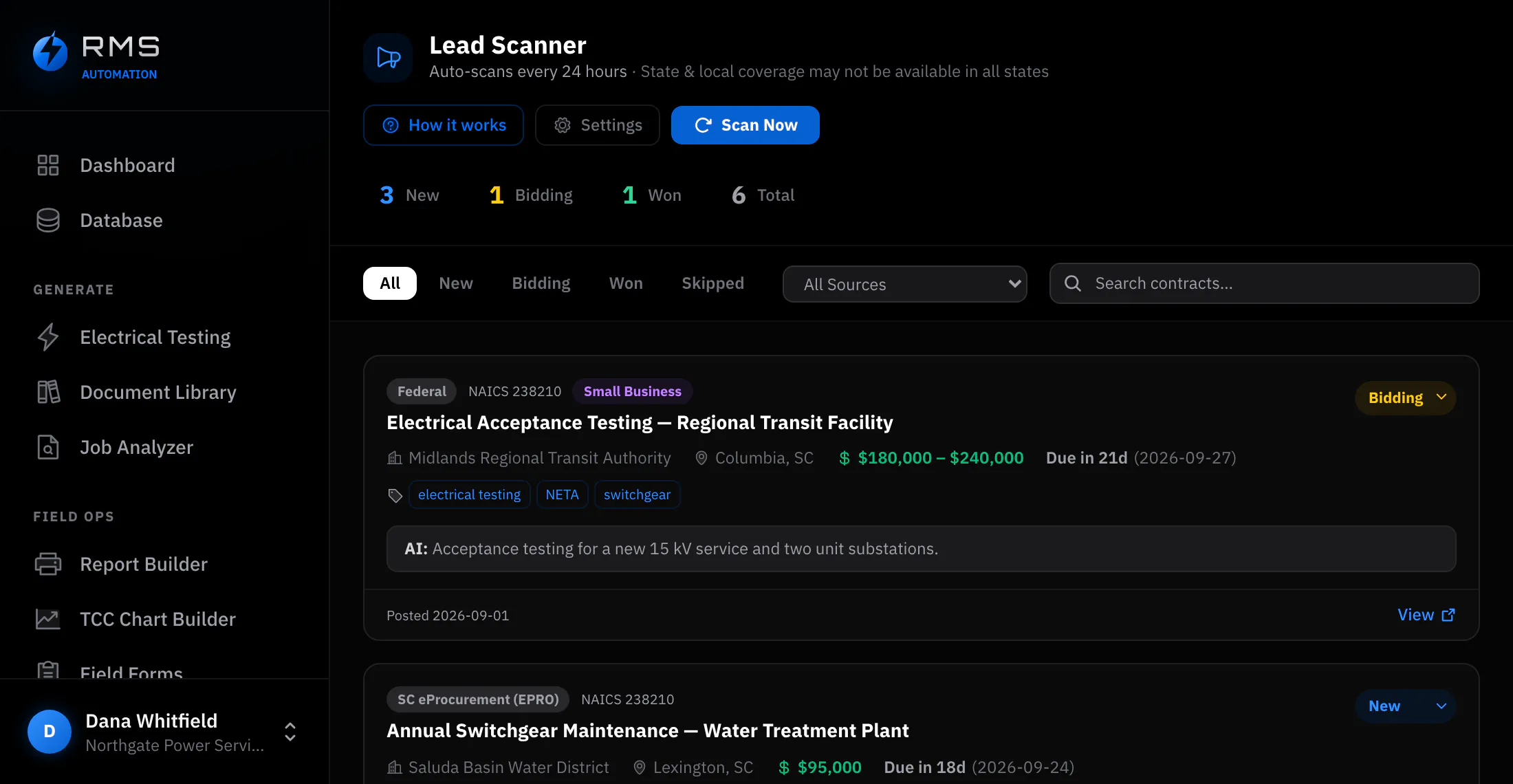
The portals, watched instead of visited
Federal, state and local procurement all publish, and none of them in the same place or the same shape. A firm doing this properly checks half a dozen sites, each returning a hundred results for “electrical” of which two are testing and ninety-eight are conduit.
The scan runs daily and filters on what the work actually is, not on the word in the title. A solicitation for switchgear maintenance that never says “acceptance testing” is still switchgear maintenance, and a keyword alert will miss it every time.
- Federal, state and local sources, checked on a schedule rather than on demand
- Filtered by scope and by distance from where you actually work
- Matched on the described work, not only on titles and category codes
- Deduplicated across portals, so one job posted three times is one entry
Enough to know whether to read it
A solicitation is a hundred and forty pages, of which four matter to the decision you are making: what the work is, where, when it closes, and whether you can meet the bonding and qualification requirements. The rest is why the packet sits unopened until the day before it is due.
Each match arrives with a summary written against those four things: explicitly a triage aid, not a substitute for the packet.
- Scope, location, closing date and headline requirements up front
- Qualification and bonding conditions surfaced early, where they are a reason not to bid
- A direct link to the original packet on the issuing portal, always
- The summary is never the thing you bid from, the packet is
One digest, in the morning
Every alerting product fails the same way: it notifies too often, it is muted within a fortnight, and it is then worse than nothing because everyone believes it is running.
So this arrives once a day, and not at all on a day with nothing to say. No badge, no push, no interruption during a shift: two minutes in the morning, readable on a phone before the first job.
- One digest a day; silent when there are no matches
- New since yesterday, and closing soon, separated
- Filters adjustable from the digest itself, not from a settings page
What it saves, and how to work it out
Not measured customer results. Every input below is an assumption, shown so you can replace it with your own figures. It counts hours of searching and nothing else, not work won.
| Line | Value |
|---|---|
| Portals worth watching in one state (assumed) | 6 |
| Checking them by hand, per week (assumed) | 90 min |
| Reading a daily digest instead, per week (assumed) | 15 min |
| Loaded owner or estimator rate (assumed) | $110 / hr |
| Saved per week | 75 min · $138 |
| Saved over a year | 65 hr · $7,150 |
The real value is not sixty-five hours; it is the solicitation you would not have seen. We are not going to quote you a win-rate uplift for it, because with no customers yet we would be making it up. What we will say is structural: work you never saw has a win rate of zero.
Who it changes the day for
You get a business development function
A small firm does not lose public work on price. It loses it by not being in the room, because the person who would have searched the portals spent the day in a switchroom and the evening writing the report from it. This is the closest thing to hiring somebody to look, bidding becomes ten minutes each morning rather than a panic when the pipeline gets thin.
Coverage without a headcount per region
An operation across several states cannot have somebody watching every county portal, so in practice it watches the regions where it already has an office. A good way to stay exactly the size it is. Scanning does not care how many jurisdictions it covers, which makes an adjacent state a filter change rather than a hire.